
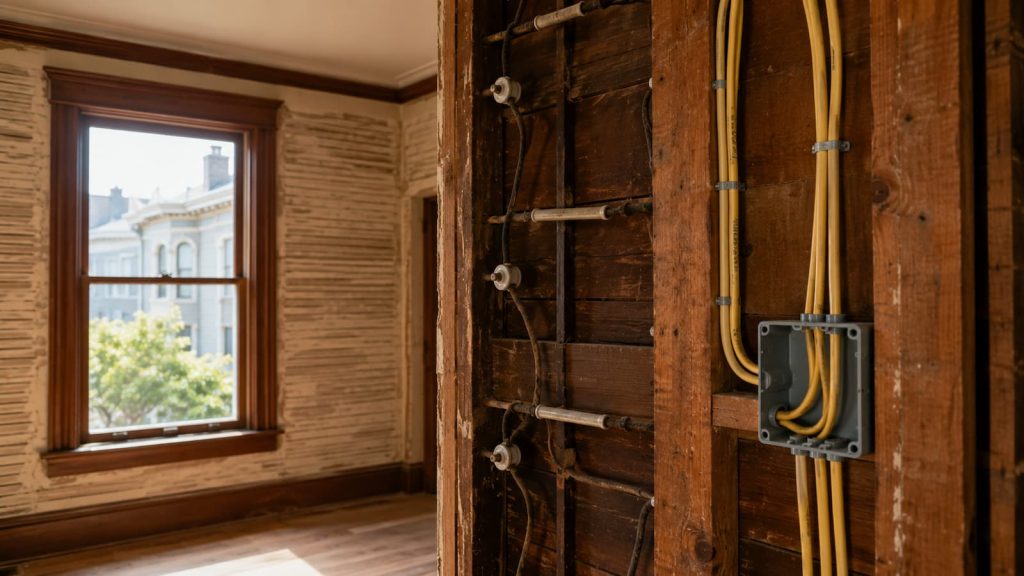
Many homeowners discover knob-and-tube wiring the same way: during a home inspection, while planning a remodel, or after an electrician investigates a recurring electrical issue. Once the wiring is identified, the next question is almost always about replacement.
The assumption is often that the only options are to leave everything as it is or completely rewire the house.
In reality, there’s a third possibility that frequently enters the conversation:
Can you replace only part of the knob-and-tube wiring?
It’s a reasonable question.
A complete rewire can be a significant investment, especially in older San Francisco homes where plaster walls, multiple stories, limited attic access, and historic architectural features increase labor. Replacing only the circuits that matter most appears, at least on the surface, to offer the best of both worlds: lower cost, less disruption, and a safer electrical system.
Sometimes that’s exactly what happens.
Other times, partial replacement creates a house with multiple generations of electrical systems, hidden transition points, and limitations that become increasingly expensive to solve later.
The answer isn’t simply yes or no.
Whether partial replacement makes sense depends on the age of the home, the condition of the existing wiring, future renovation plans, electrical capacity, and how much of the original system remains active.
For many San Francisco homeowners, understanding these tradeoffs is the difference between making a strategic investment and paying twice for essentially the same work.
This guide explains when partial knob-and-tube replacement is appropriate, when it isn’t, and why experienced electricians often recommend thinking beyond today’s project and considering the home’s electrical future.
The Short Answer
Yes, knob-and-tube wiring can sometimes be partially replaced.
However, that doesn’t mean it’s always the best solution.
A partial replacement may be appropriate when:
- Only a small portion of the original wiring remains active.
- A specific remodel affects one area of the home.
- Budget limitations require phased upgrades.
- Immediate safety concerns are isolated to particular circuits.
On the other hand, partial replacement becomes less practical when:
- Large portions of the home still rely on active knob-and-tube wiring.
- Multiple circuits are approaching the end of their service life.
- Major electrical upgrades are planned.
- The home’s electrical capacity no longer matches modern demand.
The goal isn’t simply replacing old wires.
The goal is creating an electrical system that safely supports how the home will be used for decades to come.
What Does “Partial Replacement” Actually Mean?
Homeowners often use the phrase differently than electricians do.
In practice, partial replacement usually means replacing specific active circuits while leaving other portions of the original electrical system in service.
Examples include:
- Rewiring only the kitchen.
- Replacing bedroom circuits.
- Updating second-floor wiring.
- Replacing attic lighting circuits.
- Modernizing bathroom wiring.
The remainder of the house may continue operating on existing wiring until future upgrades occur.
This differs from a complete whole-house rewire, where every active knob-and-tube circuit is permanently removed from service.
Why Homeowners Consider Partial Replacement
There are several legitimate reasons homeowners ask about replacing only part of the wiring.
Lower Initial Cost
Cost is usually the first consideration.
Replacing every branch circuit in a large Victorian or Edwardian home represents a substantial project.
Targeting only the highest-priority areas reduces the initial investment.
Less Disruption
Older San Francisco homes often feature:
- Original plaster walls
- Decorative millwork
- Historic trim
- Built-in cabinetry
- Finished attics
A complete rewire may require more access than homeowners are comfortable with.
Replacing selected circuits can minimize disruption.
Remodeling One Area
Many rewiring projects begin because another renovation is already planned.
Examples include:
- Kitchen remodel
- Bathroom renovation
- Attic conversion
- Home office addition
Since walls are already open, replacing nearby electrical wiring becomes much easier.
Addressing Immediate Safety Concerns
Sometimes an inspection identifies one clearly problematic circuit while the remainder of the system appears relatively stable.
Examples include:
- Overheated conductors
- Damaged insulation
- Improper splices
- Frequently overloaded circuits
Replacing these circuits first can improve safety while giving homeowners time to plan broader upgrades.
Why Electricians Sometimes Recommend Partial Replacement
Contrary to what many people assume, experienced electricians don’t automatically recommend a complete rewire.
Instead, they evaluate whether partial replacement accomplishes the homeowner’s goals without creating unnecessary complications.
Situations where partial replacement often makes sense include:
Recently Updated Home With Limited Remaining K&T
Some houses have already undergone substantial modernization.
Perhaps:
- The kitchen was rewired.
- Bathrooms were updated.
- Service panel was replaced.
- Laundry circuits were modernized.
Only a handful of lighting circuits remain on knob-and-tube.
In these cases, replacing those remaining circuits may effectively complete the modernization.
Localized Damage
Occasionally, only one portion of the wiring has deteriorated significantly.
Examples include:
- Water damage from roof leaks.
- Rodent damage.
- Mechanical damage during remodeling.
Targeted replacement may be the most practical solution.
Planned Phased Modernization
Some homeowners intentionally divide electrical improvements into stages.
For example:
Year One:
- Panel replacement
Year Two:
- Kitchen and laundry
Year Three:
- Upstairs bedrooms
Year Four:
- Remaining circuits
This approach allows costs to be spread over time while steadily improving the electrical system.
The Advantages of Partial Replacement
Lower Upfront Investment
Perhaps the most obvious benefit.
Instead of financing a whole-house rewire immediately, homeowners address their highest priorities first.
Better Alignment With Remodeling
Electrical work is easiest when walls are already open.
Combining rewiring with:
- Kitchen renovations
- Bathroom remodels
- Additions
- ADUs
- Basement finishing
can reduce labor and patching costs.
Faster Project Completion
Replacing several circuits often takes significantly less time than rewiring an entire house.
For homeowners with busy schedules, this can be an important consideration.
Immediate Safety Improvements
Even partial modernization can eliminate:
- Unsafe splices
- Overloaded circuits
- Damaged wiring
- Ungrounded receptacles in key areas
while planning future work.
The Hidden Drawbacks of Partial Replacement
This is where many homeowners don’t see the full picture.
While partial replacement has clear advantages, it also creates several long-term challenges that deserve careful consideration.
Mixed Electrical Systems
One of the biggest drawbacks is complexity.
Instead of one electrical system, the house now contains multiple generations of wiring.
You may have:
- Modern NM cable in the kitchen.
- BX cable upstairs.
- Original knob-and-tube in bedrooms.
- New dedicated circuits for HVAC.
- Original lighting circuits in the attic.
The result is an electrical system that’s more difficult to understand, troubleshoot, and document.
Future Projects Become More Complicated
Every future renovation begins with the question:
“What wiring is already here?”
Mixed systems require additional investigation before work begins.
This increases labor costs for:
- Remodels
- Panel upgrades
- Solar installation
- EV charging
- Home additions
The electrician must determine where modern wiring ends and older wiring begins.
Multiple Mobilization Costs
Homeowners sometimes assume phased rewiring saves money.
Sometimes it does.
Other times, each new phase requires:
- Planning
- Permits
- Setup
- Site protection
- Inspection
- Cleanup
Repeating these activities multiple times may reduce some of the savings associated with phased work.
Future Wall Access
One overlooked issue is access.
If walls are already open today, replacing additional circuits often costs much less than reopening those same walls years later.
Postponing electrical work may preserve the budget now while increasing costs later.
Hidden Risks of Mixing Old and New Wiring
A partially rewired home isn’t inherently unsafe. In fact, many older San Francisco houses have operated this way for years. The concern isn’t the presence of two different wiring methods—it’s how those systems are integrated and how well the remaining knob-and-tube wiring performs under modern conditions.
A thoughtfully planned partial upgrade is very different from decades of piecemeal modifications performed by multiple contractors or homeowners.
Transition Points Become Critical
Every place where new wiring connects to an older circuit becomes an important part of the electrical system.
A properly installed transition should include:
- An approved junction box
- Secure mechanical connections
- Appropriate wire connectors
- Accessible installation for future servicing
Poorly executed transitions can introduce:
- Loose connections
- Excess resistance
- Overheating
- Difficult troubleshooting later
This is one reason experienced electricians spend considerable time planning where old and new systems will meet.
Partial Replacement Doesn’t Increase the Capacity of Remaining Circuits
One misconception is that replacing several circuits somehow modernizes the entire electrical system.
It doesn’t.
Imagine replacing the kitchen wiring while leaving the rest of the home unchanged.
The kitchen may now support:
- Induction cooking
- Modern appliances
- GFCI protection
- Grounded receptacles
Meanwhile, the bedrooms may still rely on:
- Original branch circuits
- Two-prong outlets
- Limited circuit capacity
- Active knob-and-tube wiring
The house has improved—but only in selected areas.
Will Partial Replacement Help With Insurance?
Sometimes.
Insurance companies generally evaluate the electrical system as a whole rather than a single upgraded room.
For example:
A home with only one remaining active knob-and-tube circuit may be viewed very differently than a home where most of the original wiring is still energized.
Requirements vary by insurer, but partial replacement doesn’t automatically eliminate concerns related to older electrical systems.
If you’re navigating insurance questions, our article on How Knob-and-Tube Wiring Affects Home Insurance in San Francisco explains why different carriers evaluate older wiring differently.
What About Home Inspections?
Home inspectors frequently encounter partially upgraded electrical systems.
Their reports often include observations such as:
- Evidence of both modern and original wiring
- Active knob-and-tube wiring observed
- Electrical system appears partially updated
- Further evaluation recommended
This doesn’t necessarily discourage buyers.
However, mixed systems often lead to additional questions during real estate transactions.
Does Partial Replacement Make Future Rewiring Easier?
Usually, yes—but not always.
If the work is planned strategically, each phase becomes part of a larger modernization plan.
For example:
Phase One
- Replace electrical panel
- Upgrade service
- Install dedicated appliance circuits
Phase Two
- Kitchen
- Bathrooms
- Laundry
Phase Three
- Bedrooms
- Living areas
- Hallways
Phase Four
- Remaining lighting circuits
- Attic wiring
- Exterior circuits
Each phase builds on the previous one.
By contrast, random upgrades performed whenever a problem appears can create a confusing mixture of wiring methods and circuit layouts.
Partial Replacement and Future Home Electrification
Many San Francisco homeowners aren’t just thinking about today’s electrical needs.
They’re planning for:
- Electric vehicles
- Heat pumps
- Induction cooking
- Solar panels
- Battery storage
- ADUs
- Home offices
These projects significantly increase electrical demand.
If several major upgrades are already on the horizon, replacing only a few knob-and-tube circuits today may not provide the long-term solution you’re looking for.
In these situations, a more comprehensive electrical modernization plan often proves more efficient.
How Electricians Decide Whether Partial Replacement Makes Sense
Every home is different, but experienced electricians typically evaluate several key factors.
How Much Knob-and-Tube Wiring Remains?
If only a few circuits remain active, partial replacement may effectively complete the home’s modernization.
If most branch circuits are still original, a whole-house approach often deserves consideration.
What Condition Is the Wiring In?
Age alone doesn’t determine whether replacement is necessary.
Electricians also look for:
- Brittle insulation
- Improper splices
- Previous modifications
- Overheating
- Mechanical damage
Poor condition generally shifts the recommendation toward broader replacement.
What Are the Homeowner’s Long-Term Plans?
Future renovations matter.
Questions often include:
- Will the kitchen be remodeled?
- Is an EV charger planned?
- Will attic insulation be added?
- Are solar panels being considered?
- Is an addition planned?
Planning electrical work around future improvements can reduce duplicated labor and unnecessary expense.
Cost Comparison: Partial vs Full Replacement
While every home is different, the tradeoffs generally look like this.
| Consideration | Partial Replacement | Full Replacement |
|---|---|---|
| Initial cost | Lower | Higher |
| Construction disruption | Less | More |
| Immediate safety improvements | Targeted | Comprehensive |
| Future flexibility | Moderate | Excellent |
| Long-term maintenance | Mixed systems remain | Simpler system |
| Supports future electrification | Sometimes | Yes |
| Number of future electrical projects | Often more than one | Usually one major project |
The right choice depends on the condition of the home—not just the budget.
When Partial Replacement Is Often the Right Choice
Partial replacement is frequently appropriate when:
- Only a few active knob-and-tube circuits remain.
- The home has already undergone substantial electrical upgrades.
- Remodeling is limited to one area.
- Budget requires a phased approach.
- Remaining wiring is in good condition and scheduled for future replacement.
When a Full Rewire Usually Makes More Sense
A comprehensive replacement often becomes the better long-term investment when:
- Active knob-and-tube wiring serves much of the home.
- Multiple electrical upgrades are already planned.
- The electrical service is being upgraded.
- Energy-efficiency improvements are scheduled.
- Walls will already be opened during renovation.
- The homeowner wants to modernize the property for decades to come.
Our guide on How Long Does a Knob-and-Tube Rewire Take? explains what homeowners can typically expect during a full replacement project.
Common Misconceptions
“Partial Replacement Is Always Cheaper”
Not necessarily.
While the initial invoice is usually smaller, repeated projects over several years can sometimes cost more than completing coordinated upgrades at once.
“A New Electrical Panel Means I Don’t Need New Wiring”
A modern panel improves one part of the electrical system.
It doesn’t automatically replace branch circuits throughout the house.
“I’ll Replace the Rest Later”
Many homeowners genuinely intend to complete future phases.
Life changes.
Projects get delayed.
Years later, the house may still contain a patchwork of wiring systems.
Planning a realistic timeline is more effective than assuming future work will happen automatically.
Frequently Asked Questions
Can new wiring be connected to existing knob-and-tube wiring?
Yes, when done correctly by a qualified electrician using approved methods and accessible junction boxes.
The connection itself isn’t the problem.
The overall condition and design of the remaining system are what matter.
Can I replace only the upstairs wiring?
Yes.
Many phased rewiring projects are organized by floor, room, or renovation area.
Will partial replacement eliminate all insurance concerns?
Not always.
Insurance companies typically evaluate the entire electrical system, including any remaining active knob-and-tube wiring.
Does partial replacement increase home value?
It can.
Modernized electrical systems are generally viewed positively by buyers.
However, buyers may still ask questions if significant portions of the original wiring remain.
Should I combine rewiring with other home improvements?
In many cases, yes.
Electrical work often becomes easier and more cost-effective when coordinated with remodeling, insulation upgrades, panel replacement, or future electrification projects.
Final Thoughts
Partial replacement of knob-and-tube wiring is neither a shortcut nor a compromise by definition. In the right circumstances, it can be a practical, cost-effective way to improve safety, support renovations, and spread modernization costs over time.
The key is understanding what partial replacement does—and what it doesn’t do.
Replacing one section of the system doesn’t automatically modernize the rest of the house. Older circuits may still have limited capacity, lack grounding, or require attention as your home’s electrical needs continue to grow.
For many San Francisco homeowners, the decision isn’t simply “partial versus full.” It’s about developing a realistic long-term strategy.
A thoughtful electrical plan considers not only today’s budget but also tomorrow’s renovations, energy upgrades, and technology. Whether you’re remodeling a kitchen, preparing for attic insulation, installing an EV charger, or simply improving the safety of an older home, understanding how partial replacement fits into the bigger picture will help you make informed decisions.
If you’re unsure which approach makes the most sense for your property, a professional evaluation is the best place to start. An experienced electrician can identify which knob-and-tube circuits remain active, assess their condition, and recommend whether a targeted upgrade or a complete rewire will provide the safest and most practical solution for your home over the long term.