
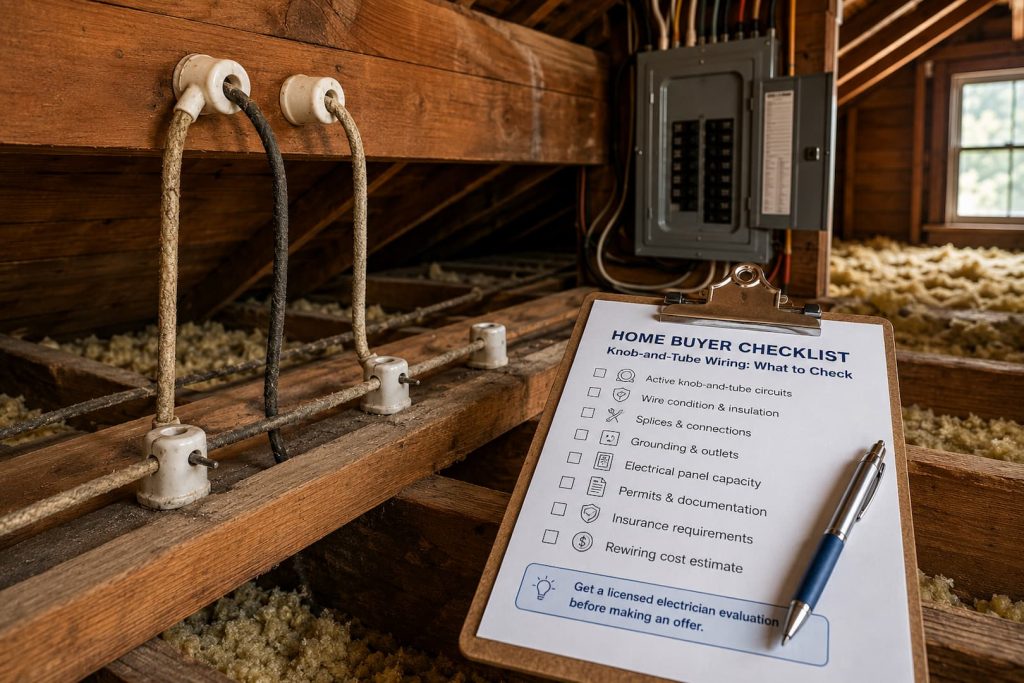
Finding knob-and-tube wiring during a home search can make an otherwise promising property feel like a gamble. The wiring may have served the house for generations. The lights may work, the panel may look relatively new, and the seller may say there have never been any electrical problems. None of that, by itself, tells you whether the system is safe, fully active, insurable, or practical for the way you plan to use the home.
This is especially important when buying an older San Francisco house. A Victorian or Edwardian property may contain original wiring in bedrooms and lighting circuits, newer cable in a remodeled kitchen, a replacement panel installed years later, and undocumented alterations connecting everything together. What looks like an “updated electrical system” may actually be several generations of work layered into one house.
Knob-and-tube wiring is not a reason to reject every property that contains it. It is a reason to slow down, investigate the full system, understand the likely cost of ownership, and make an offer based on evidence rather than assumptions.
This guide explains what buyers should check before making an offer, what a general home inspection may miss, which records to request, how insurance can affect the transaction, and when the electrical findings should change your price or contract terms.
First, Understand What Knob-and-Tube Wiring Means for a Buyer
Knob-and-tube wiring is an early electrical wiring method commonly found in homes built from the late 1800s through the first decades of the 20th century. Individual conductors were routed separately through wall, ceiling, attic, and floor cavities. Porcelain knobs supported the wires along framing, while porcelain tubes protected them where they passed through wood.
The system was appropriate for the electrical demands of its time. A house might have needed electricity for lighting, a few receptacles, and a limited number of appliances. It was not designed around modern kitchens, home offices, electric heating and cooling equipment, entertainment systems, EV charging, or dozens of devices operating at once.
The main concern is not simply that the wiring is old. The real questions are:
- How much original wiring remains active?
- What condition is the conductor insulation in?
- Has the wiring been buried under insulation?
- Were later additions and splices installed properly?
- Does the home have enough circuits and electrical capacity for modern use?
- Will an insurer issue the coverage required by your lender?
- What will it cost to correct the deficiencies after closing?
Two houses can both contain knob-and-tube wiring and present very different levels of risk. One may have a small, clearly identified lighting circuit that remains in good condition. Another may have original wiring throughout the house, deteriorated insulation, unprotected splices, overloaded circuits, and modern three-prong receptacles that are not actually grounded.
Your goal is not merely to confirm that knob-and-tube wiring exists. Your goal is to understand the extent, condition, history, and practical consequences of the system you would be buying.
Do Not Rely on the Listing Description
Real estate listings often use broad phrases such as “updated electrical,” “newer panel,” or “recently remodeled.” Those descriptions may be accurate, but they rarely explain the scope of the work.
For example, “updated electrical” could mean:
- A replacement electrical panel connected to many original circuits
- New wiring only in the kitchen and bathrooms
- Grounded receptacles added in selected rooms
- A service upgrade without a whole-house rewire
- New visible wiring in accessible areas while hidden wiring remains untouched
- Electrical work completed without clear permits or final inspection records
A modern panel does not prove that the branch-circuit wiring behind the walls is modern. New outlets do not prove that grounding conductors were installed. A remodeled room does not prove that the electrical work extended beyond that room.
Treat marketing language as a starting point for questions, not as verification.
Review the Seller Disclosures Carefully
Before making an offer—or before removing an inspection contingency if you are already under contract—review every disclosure related to the electrical system. Do not look only for the exact phrase “knob-and-tube wiring.” Sellers may describe the same issue in other ways.
Watch for references to:
- Old or original wiring
- Ungrounded outlets
- Two-prong receptacles
- Partial electrical upgrades
- Prior electrical repairs
- Flickering lights or frequently tripped breakers
- Past overheating, smoke, sparks, or electrical odors
- Insurance requirements connected to the wiring
- Work completed by a previous owner
- Permits that were opened but never finalized
Pay attention to wording such as “seller has no knowledge.” That statement does not confirm that the condition does not exist. It only describes what the seller reports knowing.
If the disclosure says electrical work was completed, ask for supporting documents. A useful response should identify what was replaced, when it was done, who performed the work, whether permits were obtained, and whether the final inspection was approved.
Request the Documents Behind Any Claimed Rewire
A seller may genuinely believe the house was rewired because a contractor replaced visible equipment or because a prior owner described the work that way. Documentation helps separate a complete rewire from a limited upgrade.
Ask for any available:
- Electrical permits
- Final inspection approvals
- Contractor proposals and invoices
- Scope-of-work descriptions
- Panel schedules
- Photos taken before walls were closed
- Warranty documents
- Insurance correspondence concerning electrical work
- Reports from prior home or electrical inspections
Read the scope carefully. An invoice stating “electrical upgrade” may cover only a panel replacement, kitchen remodel, service change, or a handful of new circuits. Look for language identifying rooms, circuits, fixtures, receptacles, and the removal or disconnection of existing knob-and-tube wiring.
No documentation does not automatically prove that the work is defective. It does mean you have less evidence and should place more weight on an independent electrical evaluation.
Check the Permit History—But Know Its Limits
San Francisco property records can help buyers understand whether electrical permits were issued for past work. Permit history may show service upgrades, panel replacements, remodels, additions, or broader rewiring projects.
When reviewing records, look for:
- The date the permit was issued
- The stated scope of electrical work
- Whether the permit was completed and finalized
- Whether the scope matches the seller’s description
- Whether later remodels appear to have included electrical work
- Whether there are open permits or unresolved complaints
Permit records are valuable, but they do not reveal everything hidden behind walls. Older work may not be fully described in an online record. Unpermitted work may not appear at all. A permit for a panel does not confirm that every branch circuit was replaced.
Use permit history to build a timeline, then compare that timeline with the physical system found during inspection.
Understand What a General Home Inspector Can—and Cannot—Tell You
A qualified home inspector can identify many visible signs of an older electrical system. The report may note ceramic knobs and tubes in an attic or basement, two-prong receptacles, an older fuse box, missing grounding, open junctions, or wiring that appears to be covered by insulation.
That information is useful. However, a standard home inspection is usually visual and noninvasive. The inspector typically does not open walls, trace every circuit through the house, disconnect conductors, or verify the condition of wiring concealed inside finished cavities.
A general inspection may not determine:
- Exactly which knob-and-tube circuits remain energized
- Whether modern receptacles are connected to old wiring
- Whether every three-prong outlet is properly grounded
- Where old and new wiring have been spliced together
- The condition of insulation inside inaccessible walls
- Whether circuit extensions were installed correctly
- How much rewiring would be required to satisfy your insurer or renovation plans
If knob-and-tube wiring is visible, disclosed, suspected, or mentioned in an earlier report, schedule a separate inspection by a licensed electrician experienced with older San Francisco homes.
What the Electrical Inspection Should Establish
The most useful electrical inspection is not a simple yes-or-no confirmation that knob-and-tube wiring exists. It should give you enough information to make a financial and practical decision.
Ask the electrician to evaluate the following areas.
Which circuits are still active?
Visible knob-and-tube wiring may be abandoned, partially abandoned, or fully energized. An electrician may need to trace circuits and test outlets, lights, switches, and accessible conductors to understand what remains in service.
This distinction matters. A few active lighting branches represent a different project from original wiring serving most bedrooms, common areas, and receptacles.
What condition is the insulation in?
Old conductor insulation can become dry, brittle, cracked, or damaged by heat, pests, remodeling, and repeated handling. The most vulnerable areas are often near fixtures, switches, junctions, and other locations where conductors were moved or exposed to heat.
Has insulation been installed around the wiring?
Knob-and-tube wiring was installed with open air around its conductors. Attic or wall insulation added later can change how heat dissipates and may hide damaged areas or improper modifications. Ask whether any active wiring is buried, surrounded, or difficult to inspect because of insulation.
Are there unsafe splices or transitions?
Many problems attributed to knob-and-tube wiring are actually caused by later alterations. A house may contain extensions added for receptacles, ceiling fans, remodeled rooms, or appliances. The electrician should look for exposed splices, inaccessible junctions, overloaded extensions, reversed polarity, and questionable transitions between old and modern wiring.
Are the outlets genuinely grounded?
A three-prong receptacle can be installed on a circuit that has no equipment grounding conductor. Its appearance alone proves nothing. Testing should determine whether grounding is present, absent, or inconsistently provided across the house.
Is the panel appropriate for the existing system?
The inspection should also consider panel condition, available breaker spaces, circuit labeling, overcurrent protection, service capacity, and signs of improper modifications. A newer panel can be an improvement, but it does not correct deteriorated branch wiring by itself.
Can the system support your intended use?
Tell the electrician what you plan to add. Your evaluation should account for more than the way the seller currently uses the home.
Potential future loads may include:
- An EV charger
- A heat pump or mini-split system
- An induction range
- An electric water heater
- A home office with substantial equipment
- A remodeled kitchen
- A laundry relocation
- An ADU or expanded living area
- Solar panels or battery storage
A system that barely supports the current occupants may be a poor fit for your plans even if it has not produced obvious symptoms.
Inspect More Than the Wiring You Can See
Visible wiring in the attic or basement is only one part of the system. Buyers should look for clues throughout the house that suggest older circuits remain active.
Common clues include:
- Two-prong receptacles
- A mix of two-prong and three-prong receptacles
- Very few outlets in bedrooms or living areas
- Surface-mounted wiring added after construction
- Old push-button switches or vintage fixture boxes
- Rooms controlled by a small number of heavily loaded circuits
- Unexplained junction boxes in closets, attics, or basements
- New wiring that disappears into old cloth-covered conductors
- Inconsistent outlet testing results from room to room
- Panel labels that are vague, incomplete, or inaccurate
None of these details proves the full condition of the system. Together, they help identify where additional investigation is needed.
Get an Insurance Answer Before You Commit
Insurance can become the deciding factor in a purchase involving knob-and-tube wiring. Some insurers may decline to issue a policy, limit coverage, require an electrical inspection, request repairs, or require replacement within a specified period. Underwriting decisions vary by insurer, the extent and condition of the wiring, the home’s other characteristics, and current market conditions.
Do not assume that coverage will be available because:
- The seller currently has insurance
- The property was insured when the seller purchased it
- A neighboring house with similar wiring is insured
- Your lender has issued an initial loan approval
- An online quote did not ask detailed wiring questions
The seller’s existing policy does not automatically transfer to you, and underwriting rules can change. Contact an insurance broker or carrier early, provide accurate information, and ask for a written explanation of any electrical conditions attached to coverage.
Questions to ask include:
- Will you insure a home with active knob-and-tube wiring?
- Do you require an electrical inspection or electrician’s certification?
- Must the wiring be fully replaced or only repaired in identified areas?
- Is coverage available during the rewiring period?
- How long would I have to complete required work?
- Would the policy contain exclusions or reduced coverage related to electrical loss?
- What documentation is required after completion?
Obtain this answer before removing an insurance or inspection contingency. A favorable purchase price does not help if you cannot secure the coverage required to close.
Find Out Whether Your Lender Has Additional Requirements
Mortgage approval and property insurance are closely connected. A lender may require evidence of acceptable insurance before funding the loan. Depending on the loan program and the property’s condition, unresolved electrical issues may also affect appraisal, repair conditions, or closing requirements.
Ask your lender:
- Whether active knob-and-tube wiring creates a property condition issue
- Whether repairs must be completed before closing
- Whether an electrician’s report will be required
- Whether repair funds can be held in escrow
- Whether your loan program allows post-closing electrical work
Do not wait until the final underwriting stage. If the property condition affects financing, you need time to adjust the offer, negotiate repairs, or evaluate another loan structure.
Get a Property-Specific Rewiring Estimate
Online cost ranges can help with early planning, but they should not determine your final offer. Rewiring costs vary substantially based on the layout and condition of the individual property.
A useful estimate should consider:
- The size and number of stories
- How much knob-and-tube wiring remains active
- Attic, basement, and crawlspace access
- Plaster-and-lath walls and ceilings
- Historic trim, built-ins, paneling, or decorative finishes
- The number and location of receptacles, switches, and fixtures
- Whether the house will be occupied during the work
- Panel or service upgrades
- Required permits and inspections
- Wall and ceiling patching
- Texture matching and painting
- Temporary power or staged work
- Future circuits for appliances and electrification
Ask the electrician to separate required corrective work from optional improvements. This makes it easier to understand the minimum cost needed for safety or insurance and the additional cost of adapting the house to your long-term plans.
Clarify What Is Included in the Estimate
Two estimates can differ dramatically because they are pricing different scopes. One may include only electrical labor. Another may include permits, fixture reconnection, panel work, wall patching, and painting.
Before using an estimate in negotiations, confirm whether it includes:
- Full replacement or only selected circuits
- Removal or disconnection of accessible old wiring
- New grounded receptacles
- New switches and device boxes
- Dedicated kitchen, laundry, bathroom, and appliance circuits
- Smoke and carbon monoxide alarm wiring where applicable
- Panel replacement or modification
- Service-capacity changes
- Permits and inspections
- Opening and closing walls
- Plaster or drywall repair
- Painting and finish restoration
- Cleanup and debris disposal
Also ask what could trigger a change order. Hidden junctions, blocked wall cavities, damaged conductors, inaccessible framing, and undocumented additions may not be fully visible until work begins.
Consider the Cost Beyond the Electrician’s Invoice
The electrical proposal is only part of the ownership impact. A buyer should also budget for the disruption and finish work that may accompany a rewire.
Possible additional costs include:
- Temporary housing
- Moving or protecting furniture
- Storage
- Plaster restoration
- Whole-wall or whole-room repainting
- Historic finish repair
- Asbestos or lead-related precautions when disturbed materials are present
- Related panel, service, or utility coordination
- Delayed move-in
- Additional circuits added while walls are accessible
These costs do not necessarily make the purchase unattractive. They do need to be part of the same decision rather than treated as unrelated future expenses.
Decide Whether the House Needs a Full or Partial Rewire
Not every home with knob-and-tube wiring requires the same scope of work. The appropriate solution depends on how much remains, where it is located, what condition it is in, and what other systems have already been modernized.
A limited project may be reasonable when:
- Only a small number of clearly identified circuits remain
- The existing system can be isolated reliably
- Most major loads already use modern dedicated circuits
- The insurer accepts the proposed scope
- The remaining areas are accessible without disproportionate damage
A full rewire becomes more likely when:
- Original wiring serves most of the house
- Circuits cannot be traced confidently
- Insulation is deteriorated or concealed
- There are numerous undocumented alterations
- Grounding is absent across large areas
- The home has too few circuits for normal use
- Your renovation plans will open walls throughout the property
- Your insurer or lender requires replacement
A partial repair should not be chosen simply because it produces the smallest immediate estimate. The remaining system must still be understandable, maintainable, and suitable for the house.
How Knob-and-Tube Wiring Can Affect Your Offer
Once you understand the wiring, insurance position, and likely repair cost, you can decide how to reflect the issue in your offer. The right structure depends on the market, the seller’s priorities, your financing, and how certain the scope is.
Option 1: Reduce the purchase price
A lower price can account for work you will complete after closing. This approach gives you control over contractor selection and project scope.
However, a price reduction does not necessarily provide the same immediate cash as a closing credit. You still need enough post-closing funds to complete the work, and the lower price may not solve an insurance requirement that must be satisfied before closing.
Option 2: Request a seller credit
A credit may help with eligible closing costs and preserve some of your cash for repairs. The amount and permitted use may be limited by your loan terms, so confirm the structure with your lender before negotiating it.
Option 3: Ask the seller to complete the work
Seller-completed work may solve an underwriting or insurance problem before closing, but it gives the buyer less control over contractor selection, access decisions, finish restoration, and the final scope.
If the seller performs the work, require a written scope, appropriate permits, final approval, invoices, and documentation showing which circuits were replaced. Avoid vague language such as “repair electrical as needed.”
Option 4: Use a repair escrow or holdback
In some transactions, funds may be held for work after closing. Whether this is available depends on the lender, insurer, contract, and nature of the repairs. It should be arranged in advance rather than assumed.
Option 5: Keep the inspection contingency
When the scope is unclear, preserving the right to investigate can be more valuable than offering the highest price with no protection. A specialist inspection provides time to determine whether the issue is a manageable upgrade or a project that changes the economics of the purchase.
Do Not Base the Negotiation on the Lowest Estimate
The lowest proposal may omit permits, wall repair, panel work, grounded receptacles, or large portions of the house. It may also assume easy access that the property does not provide.
For negotiation purposes, use an estimate that reflects a realistic, clearly written scope. Consider including a contingency for concealed conditions when the electrician cannot inspect large portions of the wiring.
The purpose of the estimate is not to produce the biggest possible concession. It is to prevent you from buying the property with an unrealistically small repair budget.
When Knob-and-Tube Wiring May Be a Manageable Issue
The presence of old wiring does not always make a house a poor purchase. It may be manageable when the buyer has accurate information, sufficient funds, and a workable insurance path.
The situation is generally easier to evaluate when:
- The remaining active circuits have been identified
- The system has not been buried under insulation
- No significant overheating or deterioration is found
- Modern circuits already serve kitchens, bathrooms, laundry, and major appliances
- The panel and service have adequate capacity
- The insurer has reviewed the condition and confirmed coverage
- The purchase price reflects the remaining work
- You can complete the upgrade before moving in or during a planned renovation
In this situation, the wiring becomes a defined capital project rather than an unknown liability.
When You Should Be More Cautious
Some findings should change the way you approach the transaction. They may not require you to walk away, but they increase uncertainty, cost, or urgency.
Be especially cautious when:
- The seller will not allow a specialist electrical inspection
- The wiring is described as replaced, but no one can define the scope
- Permit records and seller statements do not match
- Active wiring is buried under attic or wall insulation
- Insulation is cracked, missing, or visibly damaged
- Open or improvised splices are present
- Three-prong receptacles test as ungrounded
- Breakers or fuses appear oversized for connected conductors
- The panel contains crowding, corrosion, heat damage, or questionable alterations
- The house relies heavily on extension cords or power strips
- No insurer will confirm acceptable coverage
- The required work must be completed before closing, but the schedule is unrealistic
- You are already at the limit of your renovation budget
The greatest risk is not always the condition you can see. It is entering the transaction without enough time, access, or financial flexibility to determine the full scope.
Quick Buyer Checklist Before Making an Offer
| What to Check | Why It Matters | What to Request |
|---|---|---|
| Seller disclosures | Shows known electrical conditions and past repairs | Completed disclosures and written clarification |
| Permit history | Helps establish what work was authorized and finalized | Permit records, scope, and final approvals |
| Prior rewire claims | “Updated electrical” may describe limited work | Invoices, contracts, photos, and panel schedules |
| Active K&T circuits | Defines the actual extent of the problem | Circuit tracing and electrician’s findings |
| Wire condition | Deterioration may increase urgency and scope | Inspection of accessible conductors and connections |
| Grounding | Three-prong outlets may still be ungrounded | Receptacle and circuit testing |
| Panel and service | A rewire may expose capacity or equipment limitations | Panel assessment and load planning |
| Insurance | Coverage may be limited or conditioned on repairs | Written underwriting answer |
| Financing | Lender requirements may affect closing | Written guidance from the lender |
| Rewiring cost | Online averages cannot price a specific house | Property-specific written estimate |
| Wall restoration | Electrical work may require plaster or drywall repair | Clarification of patching and painting scope |
| Future electrical needs | Current capacity may not support planned upgrades | Review of EV, HVAC, kitchen, solar, or ADU loads |
Questions to Ask the Seller
- When was the electrical system last inspected?
- Has any knob-and-tube wiring been replaced or disconnected?
- Which rooms or circuits were included in the work?
- Who performed the work?
- Were permits obtained and finalized?
- Are contractor invoices or inspection reports available?
- Has an insurer ever requested electrical repairs?
- Have breakers or fuses tripped repeatedly?
- Have any outlets, switches, or fixtures become hot?
- Has there ever been a burning odor, sparking, smoke, or electrical fire?
- Was insulation added in areas containing knob-and-tube wiring?
- Were any electrical changes made during kitchen, bathroom, attic, or basement renovations?
Written answers are more useful than casual statements made during a showing. Share relevant answers and documents with your inspector, electrician, insurance representative, and real estate adviser.
Frequently Asked Questions
Should I buy a house with knob-and-tube wiring?
Possibly. The decision should depend on the extent and condition of the wiring, insurance availability, lender requirements, rewiring cost, and whether the purchase price leaves enough room for the work. The mere presence of knob-and-tube wiring does not provide enough information to decide.
Does a new electrical panel mean the house was rewired?
No. A panel can be replaced while older branch circuits remain connected to it. Verify the wiring serving outlets, lights, switches, and fixtures throughout the house.
Can a home inspector confirm that all knob-and-tube wiring was removed?
Usually not through a standard visual inspection alone. Hidden circuits may require additional testing and tracing by a licensed electrician. Permit records and rewire documentation can provide supporting evidence, but the physical system should still be evaluated.
Can I get homeowners insurance with knob-and-tube wiring?
Availability varies. Some insurers may accept the home after inspection, while others may require repairs, impose conditions, or decline coverage. Obtain a property-specific underwriting answer before committing to the purchase.
Can the seller replace the wiring before closing?
Yes, if the transaction schedule, permits, contractor availability, insurance requirements, and contract terms allow it. The buyer should require a defined scope and complete documentation rather than relying on a general promise to “update the electrical.”
Is a price reduction equal to receiving money for the repair?
Not necessarily. A lower purchase price may reduce the loan amount, but it does not automatically provide enough cash after closing to pay the electrician. Compare the financial effect of a price reduction, seller credit, completed repair, or other approved structure with your lender and real estate adviser.
Should I rewire before moving in?
When a substantial rewire is already planned, completing it before move-in can reduce disruption and make walls, rooms, closets, and work areas easier to access. The best timing depends on the condition of the wiring, insurance deadlines, project scope, and your housing arrangements.
Final Thoughts
Buying a house with knob-and-tube wiring is not simply a choice between ignoring the system and walking away from the property. The better approach is to replace uncertainty with specific information.
Before making an offer, determine what wiring remains active, how it has been modified, whether it can be insured, what your lender requires, and what a realistic correction will cost. Verify claims of prior upgrades with permits and documentation. Use a specialist electrical inspection to investigate what a general inspection cannot establish.
Once the scope is clear, the electrical system becomes part of the purchase calculation. You can adjust the price, request a credit, require documented repairs, preserve contingencies, or decide that the project does not fit your budget.
The most expensive outcome is often not buying a house with old wiring. It is buying one without understanding how much of that wiring remains, what it will take to replace it, and whether you can close and insure the property on the terms you expected.