
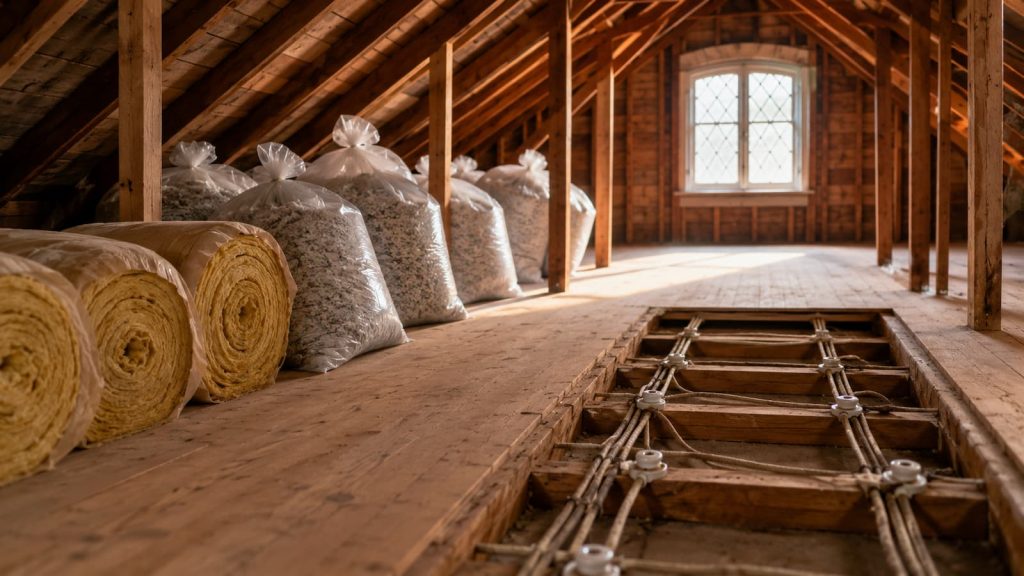
If you own an older home in San Francisco, improving energy efficiency is probably on your list of future upgrades. Rising utility costs, inconsistent indoor temperatures, and California’s growing emphasis on sustainable homes have motivated many homeowners to add attic insulation as one of their first energy improvements.
Then an insulation contractor climbs into the attic, spots ceramic knobs and cloth-covered wires, and suddenly the project comes to a stop.
“We can’t insulate over this wiring.”
For many homeowners, that’s the first time they’ve heard that knob-and-tube wiring and attic insulation can be incompatible.
The obvious question follows:
Can you add attic insulation over knob-and-tube wiring?
In most cases, the answer is no—not while the wiring remains active.
The reason isn’t simply that the wiring is old. It’s because knob-and-tube wiring was engineered around a completely different method of heat dissipation than modern electrical systems. Covering active conductors with insulation fundamentally changes the environment they were designed to operate in.
For San Francisco homeowners, this issue is especially common. Victorian, Edwardian, Craftsman, and other early-20th-century homes often retain active knob-and-tube wiring in attic spaces even after kitchens, bathrooms, or electrical panels have been updated.
Understanding why insulation creates concerns—and what your options are—can help you plan both your energy upgrades and your long-term electrical improvements without expensive surprises.
The Short Answer
If active knob-and-tube wiring is present in your attic, you generally should not install thermal insulation over it.
This applies to:
- Blown-in cellulose insulation
- Blown fiberglass insulation
- Fiberglass batts
- Mineral wool
- Spray insulation installed in ways that surround the conductors
The concern isn’t that insulation somehow damages the wiring.
The concern is heat.
Knob-and-tube wiring depends on free air surrounding each conductor. Once that airflow disappears, the operating conditions change dramatically.
Why Knob-and-Tube Wiring Was Designed for Open Air
Modern electrical cable bundles multiple conductors together inside protective insulation.
Knob-and-tube wiring follows an entirely different philosophy.
Instead of bundled cable, it uses:
- Individual hot conductors
- Individual neutral conductors
- Ceramic knobs attached to framing
- Porcelain tubes where wires pass through wood
Each wire is suspended separately, leaving open space around it.
This wasn’t accidental.
It allowed heat produced during normal electrical operation to dissipate into the surrounding air.
For the electrical demands of the early 1900s, this system worked well.
At the time, homes typically powered:
- Incandescent lighting
- Radios
- Small household appliances
- Ceiling fixtures
Continuous high electrical loads simply weren’t part of residential life.
Why Attic Insulation Changes Everything
Insulation works by slowing heat transfer.
That’s exactly what makes homes more comfortable.
It’s also exactly why insulation becomes problematic around active knob-and-tube wiring.
Instead of allowing heat to escape freely, insulation traps it around the conductors.
That means:
- Wire temperatures remain higher
- Cooling becomes less effective
- Thermal stress increases over time
While a single afternoon of trapped heat isn’t likely to cause immediate failure, years of elevated operating temperatures can accelerate deterioration of already aging electrical insulation.
Isn’t the Wiring Already 100 Years Old?
This is an understandable question.
Many homeowners point out that the wiring has worked for decades.
Why would insulation suddenly become a problem?
Because the environment has changed.
Originally, the wiring was installed in attics with:
- Open rafters
- No thermal insulation
- Plenty of airflow
Decades later, homeowners often improve energy efficiency by adding:
- Blown cellulose
- Fiberglass batts
- Loose-fill fiberglass
- Air sealing measures
The wiring hasn’t changed.
The conditions around it have.
Why This Issue Is Especially Common in San Francisco
San Francisco contains one of the country’s largest concentrations of older residential housing.
Many homes still contain at least portions of their original electrical systems.
At the same time, homeowners increasingly pursue:
- Energy retrofits
- Higher insulation values
- Heat pump installations
- Solar systems
- Electric vehicles
- Lower heating and cooling costs
Attic insulation is usually one of the first improvements recommended during energy audits.
That’s when knob-and-tube wiring often becomes part of the conversation.
Does Every Home With Knob-and-Tube Wiring Have This Problem?
Not necessarily.
The key phrase is active knob-and-tube wiring.
There are three common scenarios.
Active Wiring
The conductors still supply electricity.
This is the situation where insulation becomes problematic.
Abandoned Wiring
Previous rewiring projects disconnected the old wiring permanently.
Inactive wiring generally doesn’t present the same concern because it no longer carries electrical current.
However, many electricians recommend removing abandoned wiring when practical to reduce confusion during future inspections or renovations.
Mixed Systems
This is perhaps the most common situation in San Francisco.
The home may have:
- New kitchen wiring
- New bathroom circuits
- Modern electrical panel
- Active knob-and-tube lighting circuits remaining in the attic
Homeowners are often surprised to learn that only part of the electrical system has been modernized.
How Electricians Determine Whether Knob-and-Tube Wiring Is Still Active
It’s impossible to determine simply by looking at ceramic knobs.
An electrician typically investigates:
- Electrical panel connections
- Branch circuit routing
- Junction boxes
- Lighting circuits
- Continuity and voltage
Sometimes wiring that appears original has already been disconnected.
Sometimes wiring hidden beneath insulation is still energized.
Assumptions aren’t enough.
Testing is.
Why Insulation Contractors Often Stop the Job
Homeowners occasionally become frustrated when insulation contractors refuse to continue.
In reality, they’re usually protecting both the homeowner and themselves.
Responsible contractors know that covering active knob-and-tube wiring may create problems later.
Rather than proceeding and hoping for the best, they’ll often recommend an electrical evaluation first.
Although it may feel like a delay, it usually prevents much larger issues down the road.
Types of Insulation That Raise Concerns
The concern isn’t limited to one insulation product.
Blown-In Cellulose
One of the most common attic retrofit materials.
Because it completely surrounds wiring, it significantly reduces airflow around conductors.
Loose-Fill Fiberglass
Similar concerns apply.
Although fiberglass behaves differently than cellulose, it still reduces heat dissipation.
Fiberglass Batts
Even batt insulation can trap heat if installed directly over active wiring.
Mineral Wool
Mineral wool provides excellent thermal performance but still changes the cooling environment around knob-and-tube conductors.
Does Spray Foam Change the Situation?
Closed-cell and open-cell spray foam introduce additional considerations.
Besides thermal issues, spray foam can:
- Conceal wiring permanently
- Make future inspections difficult
- Complicate future rewiring
Most electricians recommend resolving active knob-and-tube wiring before spray foam insulation is installed.
What Happens If Someone Already Covered the Wiring?
This is surprisingly common.
Many homeowners discover years later that previous insulation projects buried active knob-and-tube circuits.
That doesn’t necessarily mean an emergency exists.
However, it does justify a professional evaluation.
The electrician may recommend:
- Confirming whether the wiring is still energized
- Assessing overall condition
- Identifying overloaded circuits
- Developing a modernization plan
Simply removing insulation isn’t always the best answer.
The wiring itself may already be due for replacement.
Why Heat Matters More Than Age
People often assume age alone determines whether wiring is safe.
Age certainly matters.
But operating temperature often matters even more.
Electrical insulation naturally degrades over time.
Consistently elevated temperatures accelerate that process.
When older cloth or rubber insulation becomes brittle, the likelihood of cracking, deterioration, and future electrical problems increases.
This is one reason electricians evaluate the overall condition of the wiring—not just its age.
Other Attic Conditions That Can Increase Risk
Attics present several additional challenges beyond insulation.
These include:
Rodent Activity
Rodents may chew older insulation from conductors.
Moisture
Roof leaks can affect framing and electrical components.
Previous DIY Repairs
Improper splices remain surprisingly common in older homes.
Mechanical Damage
Storage platforms, HVAC installations, and remodeling projects sometimes disturb older wiring.
Each of these conditions deserves attention independently of the insulation question.
Why Partial Electrical Upgrades Don’t Always Solve the Problem
Many homeowners believe they’ve already modernized their electrical system because:
- The panel was replaced
- The kitchen was remodeled
- Bathrooms were updated
Yet attic lighting circuits often remain original.
This creates a mixed electrical system where:
- Some wiring is modern.
- Some wiring is nearly a century old.
Adding insulation without understanding which circuits remain active can create unnecessary risk.
Energy Efficiency vs Electrical Safety
Homeowners sometimes feel forced to choose between:
- Lower utility bills
- Electrical safety
Fortunately, that isn’t usually necessary.
The better approach is planning improvements in the right order.
For many homes, the sequence looks like this:
- Evaluate existing wiring.
- Replace active knob-and-tube circuits where appropriate.
- Complete any necessary panel or service upgrades.
- Install attic insulation.
- Continue with additional energy improvements.
Approaching the project this way protects both the electrical system and the investment in insulation.
Is Rewiring Always Required Before Adding Attic Insulation?
Not always—but it’s one of the most common outcomes when active knob-and-tube wiring is found in the attic.
The recommendation depends on several factors:
- Whether the wiring is still energized
- How much of the home is served by knob-and-tube circuits
- The overall condition of the wiring
- Your long-term renovation plans
- Whether additional electrical upgrades are already being considered
In some homes, only a small section of the attic contains active knob-and-tube wiring. In others, nearly every lighting circuit still passes through the attic using the original conductors.
The more extensive the remaining K&T system, the more likely it makes sense to replace it before insulating.
Can You Just Leave the Attic Uninsulated?
Technically, yes.
Practically, it’s rarely the best long-term solution.
An uninsulated attic contributes to:
- Higher heating costs during cooler months
- Increased heat gain during the summer
- Less consistent indoor temperatures
- Reduced overall energy efficiency
- Greater strain on HVAC systems
Many San Francisco homeowners are surprised by how much heat is lost through an uninsulated ceiling.
Choosing not to insulate simply to avoid addressing outdated wiring often postpones—not solves—the underlying issue.
Should You Remove the Old Knob-and-Tube Wiring?
Homeowners often ask whether the old wiring must be physically removed once it’s replaced.
The answer depends on the project.
Option 1: Abandon in Place
In many rewiring projects, inactive knob-and-tube wiring is permanently disconnected and left inside wall cavities or attic framing.
Advantages include:
- Less disruption
- Faster installation
- Reduced labor
Option 2: Remove the Old Wiring
In some situations, electricians remove accessible sections of old wiring while completing the rewire.
Removal may make sense when:
- The attic is already open
- Major renovations are underway
- The wiring interferes with new work
- Homeowners prefer eliminating obsolete infrastructure
Either approach should leave no active knob-and-tube circuits beneath new insulation.
What Happens During an Electrical Evaluation?
If an insulation contractor identifies knob-and-tube wiring, the next step is usually an electrical assessment.
A typical evaluation includes:
Identifying Active Circuits
The electrician determines which portions of the old wiring still carry electricity.
Inspecting the Attic
The inspection often looks for:
- Ceramic knobs and tubes
- Splices
- Cloth insulation condition
- Previous repair work
- Signs of overheating
Reviewing the Electrical Panel
The panel reveals how older circuits connect to the rest of the home’s electrical system.
It’s common to find a modern breaker panel feeding branch circuits that were never replaced.
Evaluating Future Plans
Good electricians don’t just look at today’s insulation project.
They also ask about future upgrades such as:
- EV charging
- Heat pumps
- Solar panels
- Kitchen remodeling
- Home additions
Understanding your long-term goals helps determine whether a targeted repair or full rewiring makes more financial sense.
Why This Often Becomes a Whole-Home Planning Conversation
Attic insulation frequently starts as a simple energy-efficiency project.
Then homeowners discover:
- Active knob-and-tube wiring
- Limited electrical capacity
- Aging branch circuits
- Older panels
- Ungrounded receptacles
Rather than viewing these as separate projects, many homeowners choose to coordinate them.
For example:
- Replace active knob-and-tube wiring.
- Upgrade the electrical panel if needed.
- Add attic insulation.
- Install an EV charger.
- Prepare the home for future electrification.
Bundling improvements often reduces disruption because electricians and insulation contractors aren’t working around one another months apart.
Can You Insulate Around Knob-and-Tube Wiring Instead?
This question comes up frequently.
Some homeowners ask whether it’s possible to simply leave a small gap around the wiring.
In practice, this is rarely a practical long-term solution.
Why?
Because:
- It’s difficult to maintain consistent clearance throughout an attic.
- Future insulation work may cover the wiring anyway.
- Homeowners often forget exactly where the wiring runs.
- Air gaps reduce insulation performance.
- The remaining active wiring still limits future improvements.
Instead of designing insulation around obsolete wiring, most long-term renovation plans focus on replacing the wiring first.
What About Spray Foam “Carefully Applied Around the Wiring”?
Some homeowners wonder whether careful spray foam installation changes the equation.
Generally, no.
Spray foam introduces additional complications because it:
- Encapsulates wiring.
- Makes future inspection difficult.
- Makes future rewiring more disruptive.
- Permanently limits access.
For homes with active knob-and-tube wiring, electricians typically recommend resolving the electrical system before spray foam is installed.
Common Mistakes Homeowners Make
Assuming the Wiring Was Already Replaced
A new electrical panel doesn’t necessarily mean the entire house has been rewired.
Many San Francisco homes contain a mixture of modern and original circuits.
Starting With the Insulation Contractor
There’s nothing wrong with getting insulation quotes first.
But if the home is older, an electrical evaluation before finalizing insulation plans can save time.
Ignoring the Attic
Because most homeowners rarely enter their attic, electrical problems often go unnoticed for years.
The attic deserves attention whenever major energy upgrades are planned.
Thinking the Problem Is “Just the Attic”
Active knob-and-tube wiring visible in the attic usually means it continues elsewhere in the home.
The visible portion is often only part of a larger electrical system.
Planning Your Projects in the Right Order
If your home still contains active knob-and-tube wiring and you’re considering energy upgrades, a logical sequence is often:
- Perform an electrical inspection.
- Determine whether knob-and-tube wiring remains active.
- Develop a rewiring plan if necessary.
- Complete any required panel or service upgrades.
- Install attic insulation.
- Continue with additional improvements such as solar panels, heat pumps, or EV charging.
This sequence minimizes rework and helps ensure each upgrade supports the next.
Frequently Asked Questions
Does every house with knob-and-tube wiring have to delay insulation?
No.
The determining factor is whether the wiring in the attic is still active. Inactive wiring that has been permanently disconnected presents a different situation than energized conductors.
Can insulation cause knob-and-tube wiring to fail immediately?
Usually not.
The concern is cumulative heat buildup over time rather than instant failure.
Elevated operating temperatures can accelerate insulation deterioration and increase long-term risk.
Is blown-in cellulose worse than fiberglass?
Both reduce airflow around conductors.
The specific material matters less than the fact that active wiring becomes surrounded by insulation rather than exposed to open air.
Will replacing only the attic wiring solve the problem?
Sometimes.
If only attic lighting circuits remain on knob-and-tube wiring, targeted replacement may be appropriate.
If active K&T wiring exists throughout the home, a broader rewiring strategy often makes more sense.
Can I still improve my home’s energy efficiency if I have knob-and-tube wiring?
Absolutely.
Many San Francisco homeowners modernize both their electrical systems and energy performance.
The key is completing projects in the right order rather than allowing one improvement to interfere with another.
Final Thoughts
Attic insulation is one of the best investments many homeowners can make. It improves comfort, reduces energy consumption, and helps older homes perform more efficiently throughout the year.
However, homes built during the early decades of the twentieth century often contain electrical systems that were never intended to operate inside insulated building assemblies.
Active knob-and-tube wiring depends on open-air cooling. Covering those conductors with insulation changes the conditions under which the system was originally designed to operate.
That doesn’t mean every home requires an immediate whole-house rewire. It does mean that insulation projects should begin with a proper electrical evaluation whenever active knob-and-tube wiring may be present.
For many San Francisco homeowners, the most cost-effective long-term solution is to combine electrical modernization with energy-efficiency improvements. Replacing aging knob-and-tube wiring before insulating the attic creates a safer electrical system, removes a common obstacle to future renovations, and allows insulation to perform as intended.
If your home still contains active knob-and-tube wiring and you’re planning to improve energy efficiency, it’s worth discussing both projects together. A qualified electrician can determine whether the existing wiring remains active, explain how it affects insulation plans, and recommend the most practical path forward based on your home’s layout, electrical capacity, and long-term renovation goals.
By approaching the project in the right sequence, you can improve comfort, reduce energy costs, and modernize your home’s electrical infrastructure without creating conflicts between today’s upgrades and tomorrow’s plans.