
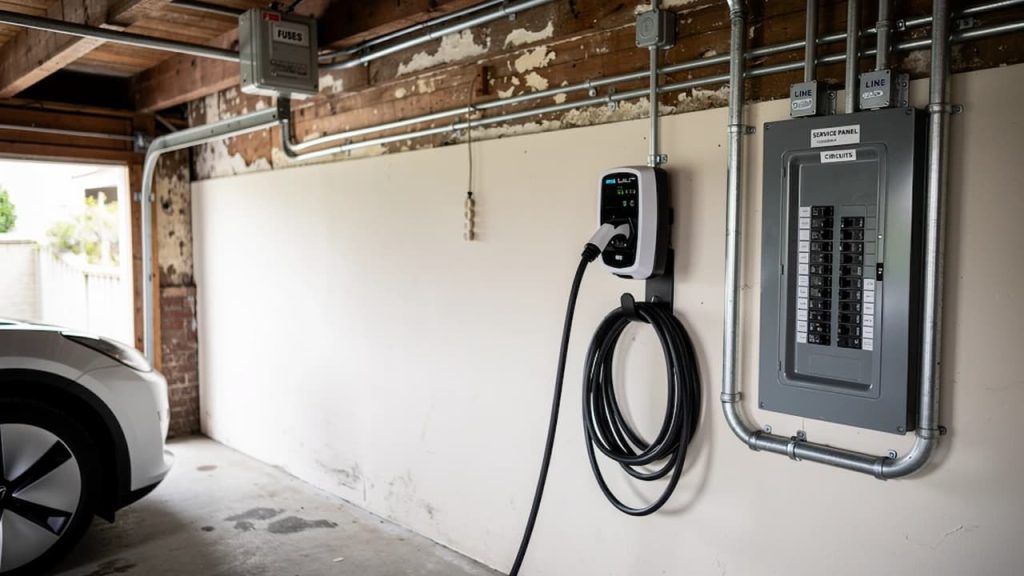
Electric vehicles are becoming increasingly common throughout San Francisco. Whether it’s a Tesla parked in Noe Valley, a Rivian in Bernal Heights, a Ford F-150 Lightning in the Sunset, or a Hyundai Ioniq 5 charging overnight in the Richmond District, EV adoption continues to grow across the city.
For homeowners living in newer construction, adding a charger is often relatively straightforward. For owners of older Victorians, Edwardians, Craftsman homes, and pre-war properties, the conversation is usually more complicated.
One of the most common questions electricians hear today is:
“Can I install an EV charger if my home still has knob-and-tube wiring?”
The short answer is:
Sometimes—but the answer depends far less on the charger itself and far more on the overall condition and capacity of the electrical system.
Many homeowners assume the charger is the challenge. In reality, the charger is often what exposes limitations that have existed in the home for years.
A house that functioned adequately for lighting, televisions, laptops, and kitchen appliances may suddenly be asked to support a continuous 32-amp, 40-amp, or even 48-amp charging load for several hours every night.
That changes the conversation dramatically.
This guide explains how EV chargers interact with older electrical systems, why knob-and-tube wiring often becomes part of the discussion, and what San Francisco homeowners should know before purchasing charging equipment.
Understanding EV Charger Power Requirements
Before discussing knob-and-tube wiring specifically, it’s important to understand why EV chargers place unique demands on residential electrical systems.
Level 1 Charging
Level 1 charging uses a standard household outlet.
Typical characteristics:
- 120 volts
- 12–16 amps
- Slow charging speed
- Approximately 3–5 miles of range per hour
Because power demand is relatively low, many homeowners use Level 1 charging temporarily without making electrical modifications.
However, for most daily drivers, Level 1 quickly becomes inconvenient.
Level 2 Charging
Level 2 charging is what most homeowners eventually want.
Typical characteristics:
- 240 volts
- 20–60 amps
- Much faster charging
- Suitable for overnight charging
This is where older electrical systems often face challenges.
Unlike occasional appliance usage, EV charging is considered a continuous load.
That means the electrical system must safely supply power for extended periods.
A Level 2 charger may operate:
- 4 hours
- 6 hours
- 8 hours
- 10+ hours
on a regular basis.
Continuous loads require careful electrical planning.
Why EV Chargers Expose Electrical System Limitations
Many homeowners wonder:
“My house works fine now. Why would adding a charger be a problem?”
Because existing electrical demand and EV charging demand are fundamentally different.
Your home may currently power:
- Lighting
- Refrigerator
- Television
- Computers
- Small appliances
without issue.
An EV charger introduces a large dedicated load that wasn’t part of the home’s original design.
In older San Francisco homes, this often raises questions about:
- Service size
- Panel capacity
- Circuit availability
- Grounding
- Existing wiring condition
Knob-and-tube wiring frequently enters the conversation because it is often associated with homes that have not received comprehensive electrical modernization.
What Knob-and-Tube Wiring Was Designed to Support
When knob-and-tube wiring was installed, household electrical usage looked very different.
Common loads included:
- Incandescent lighting
- Small fans
- Radios
- Basic appliances
The electrical expectations of a 1920 homeowner were dramatically lower than those of a modern household.
Today, many homes simultaneously power:
- Computers
- TVs
- Home office equipment
- HVAC systems
- Electric dryers
- Induction ranges
- Battery storage systems
- Electric vehicles
Knob-and-tube wiring was never designed with these loads in mind.
That doesn’t automatically mean it cannot coexist with an EV charger—but it does mean the entire electrical system must be evaluated carefully.
Does the EV Charger Connect to Knob-and-Tube Wiring?
This is one of the most important misconceptions to clear up.
In a properly installed EV charging system:
The charger should never be connected to an existing knob-and-tube circuit.
Instead, electricians install:
- A new dedicated circuit
- Properly sized conductors
- Appropriate breaker protection
- Modern grounding
The EV charger receives an entirely new electrical path back to the panel.
So if the charger gets its own circuit, why does knob-and-tube matter?
Because the charger still depends on the home’s overall electrical infrastructure.
The Real Question: Can Your Electrical Service Handle the Load?
When evaluating an EV charger installation, electricians don’t simply look at the charger.
They evaluate the entire electrical system.
Questions include:
What size is the electrical service?
Common service sizes include:
- 60 amp
- 100 amp
- 125 amp
- 200 amp
Many older San Francisco homes still operate on services that were installed decades ago.
How much existing demand already exists?
The electrician evaluates:
- HVAC equipment
- Electric water heaters
- Laundry equipment
- Kitchen loads
- Existing subpanels
- Future electrical plans
Is there room in the panel?
Even if service capacity is adequate, the panel must have space for:
- New breakers
- Dedicated EV charging circuit
How Electricians Evaluate an Older Home Before Installing an EV Charger
One of the biggest surprises for homeowners is that the EV charger itself is often the easiest part of the project.
The real work happens before the charger is even selected.
A qualified electrician typically performs a comprehensive evaluation that looks at the entire electrical system—not just the garage wall where the charger will eventually be mounted.
Step 1: Verify Service Capacity
The first question is simple:
How much power can the house safely support?
Many older San Francisco homes still operate on:
- 60-amp service
- 100-amp service
- Older 125-amp service configurations
Modern homes increasingly require:
- 200-amp service
- Higher-capacity panels
- Additional dedicated circuits
An EV charger may consume more electricity than any other appliance in the home.
A Level 2 charger drawing 40 amps continuously represents a significant addition to household electrical demand.
Step 2: Perform a Load Calculation
A load calculation estimates how much electricity the home uses now—and how much it may use in the future.
Electricians consider:
Existing Major Loads
- Electric range
- Oven
- Dryer
- Water heater
- HVAC equipment
- Mini-splits
- Hot tubs
- Workshop equipment
General Household Loads
- Lighting
- Receptacle circuits
- Kitchen circuits
- Laundry circuits
Future Planned Loads
- EV chargers
- Heat pumps
- Solar battery systems
- ADU electrical systems
Many homeowners discover that the EV charger is only one piece of a broader modernization plan.
Step 3: Evaluate Existing Wiring
This is where knob-and-tube wiring enters the discussion.
The electrician wants to determine:
- Which circuits still use K&T
- Which circuits have been replaced
- Whether unsafe modifications exist
- Whether any active K&T circuits affect future expansion
This doesn’t automatically mean a full rewire is required.
However, it frequently influences recommendations.
When Knob-and-Tube Wiring Becomes a Problem for EV Charger Installation
There is no electrical code that says:
“A home with knob-and-tube wiring may not have an EV charger.”
The issue is more practical than that.
Electricians are evaluating overall system safety and capacity.
Several scenarios commonly arise.
Scenario 1: The Home Has Limited Service Capacity
This is extremely common in older neighborhoods.
The house may have:
- Active knob-and-tube wiring
- A 100-amp service
- Limited panel space
- Growing electrical demands
The charger becomes the project that finally pushes the system beyond its practical limits.
In this situation, the recommendation may include:
- Service upgrade
- Panel replacement
- Additional modernization work
Scenario 2: Knob-and-Tube Wiring Is Still Supporting Major Portions of the Home
Some homes still rely on K&T circuits for:
- Bedrooms
- Living rooms
- Hallways
- Lighting circuits
Technically, a new EV circuit could still be added.
However, many homeowners choose to address the aging wiring at the same time rather than investing heavily in one part of the system while leaving another part untouched.
Scenario 3: Existing Conditions Raise Safety Concerns
During an inspection, electricians may discover:
- Improper splices
- Brittle insulation
- Overloaded circuits
- Ungrounded systems
- Hidden modifications
At that point, the discussion expands beyond EV charging.
The charger isn’t creating the problem—it simply revealed it.
Why Dedicated Circuits Matter for EV Chargers
One reason EV chargers are handled differently from many other appliances is that they require a dedicated circuit.
That means:
- No shared outlets
- No shared lighting
- No shared appliance loads
The circuit exists solely for vehicle charging.
This approach provides:
Improved Safety
Dedicated circuits reduce overheating risks.
Predictable Performance
Charging speeds remain consistent.
Easier Troubleshooting
Electrical issues are easier to isolate.
Code Compliance
Modern charging installations require dedicated protection and proper conductor sizing.
None of this is compatible with traditional knob-and-tube branch circuits.
Why Grounding Matters for EV Charging
Grounding becomes especially important when discussing electric vehicles.
Unlike a lamp or toaster, an EV charger is:
- Permanently installed
- High-powered
- Connected for extended periods
- Used frequently
Modern EV charging equipment relies on grounding for safe operation.
A properly installed charger requires:
- Grounded conductors
- Modern breaker protection
- Approved wiring methods
This is another reason why existing knob-and-tube wiring cannot simply be repurposed for EV charging.
Common EV Charger Configurations in Older SF Homes
Not every project looks the same.
Option 1: EV Charger Added to an Otherwise Modernized Home
This is the easiest scenario.
Characteristics:
- Modern panel
- Modern wiring
- Adequate service size
- Available breaker space
The charger installation may be relatively straightforward.
Option 2: Modern Panel, Mixed Wiring Throughout House
This is extremely common.
The home may have:
- Updated kitchen circuits
- Updated bathroom circuits
- Active knob-and-tube elsewhere
In these cases, electricians often focus on:
- Service capacity
- Panel condition
- Charger circuit installation
while helping the homeowner develop a long-term upgrade plan for remaining K&T wiring.
Option 3: Original Wiring and Older Service
This scenario frequently requires larger upgrades.
The project may include:
- New panel
- Service upgrade
- Charger circuit
- Partial or full rewiring
Many homeowners discover that the EV charger becomes the catalyst for broader electrical modernization.
Can You Install a Tesla Wall Connector in a Home With Knob-and-Tube Wiring?
This question comes up frequently.
The answer is essentially the same as any Level 2 charger.
The charger itself isn’t the issue.
The concerns are:
- Service capacity
- Panel condition
- Available load
- Overall electrical system health
A Tesla Wall Connector, like other Level 2 chargers, requires:
- Dedicated circuit
- Proper grounding
- Appropriate breaker sizing
- Modern installation methods
The existence of knob-and-tube wiring elsewhere in the house doesn’t automatically prevent installation.
However, it often becomes part of the overall evaluation.
EV Chargers and Service Upgrades: Why These Projects Often Happen Together
Many homeowners initially budget for:
- Charger purchase
- Installation labor
Then discover they also need:
- Panel upgrades
- Service upgrades
- Wiring improvements
Why?
Because modern electrical demand is increasing rapidly.
A home may already be supporting:
- Heat pump HVAC
- Electric dryer
- Induction range
- Home office equipment
Adding EV charging can push the system beyond comfortable operating margins.
Common Upgrade Path
| Existing Condition | Typical Recommendation |
|---|---|
| 60-amp service | Service upgrade usually required |
| 100-amp service with heavy loads | Further evaluation needed |
| 200-amp service | Often charger-ready |
| Active K&T + limited capacity | Modernization often recommended |
This doesn’t mean every house needs a complete overhaul.
It simply means every house needs an honest assessment.
What About Multi-Unit Buildings and San Francisco Flats?
Many San Francisco homeowners live in:
- Duplexes
- Triplexes
- TIC properties
- Multi-unit buildings
EV charger installation becomes more complicated because electrical capacity may be shared.
Questions include:
Who Owns the Electrical Service?
Separate meters?
Shared service?
Common area panels?
Is Additional Capacity Available?
Many older multi-unit properties were never designed for EV charging.
Does Existing Wiring Need Upgrading?
Sometimes the charger itself is easy.
Getting sufficient power to the parking area is the challenge.
Solar Panels, Batteries, and EV Chargers
An increasing number of homeowners ask about:
- Solar panels
- Battery storage
- EV charging
all at the same time.
This combination can be powerful.
However, it requires careful planning.
The Good News
Modernized electrical systems can often support:
- Solar
- Battery storage
- EV charging
simultaneously.
The Challenge
Homes with active knob-and-tube wiring frequently need upgrades before these technologies can be fully integrated.
Many homeowners find it makes sense to develop a comprehensive modernization plan rather than addressing each project individually.
Does Installing an EV Charger Increase the Need to Replace Knob-and-Tube Wiring?
In many cases, yes.
Not because the charger physically uses knob-and-tube wiring.
Instead, the charger often highlights broader questions:
- How long will the existing wiring remain practical?
- Will future upgrades require additional work?
- Is it worth investing in charging infrastructure while leaving major portions of the home on century-old wiring?
This is why electricians often discuss charger installation and rewiring in the same conversation.
If significant knob-and-tube wiring remains active, homeowners frequently explore whether a complete upgrade makes more sense long-term.
Our guide on Do I Need to Replace Knob-and-Tube Wiring in My San Francisco Home? provides a deeper look at how homeowners evaluate that decision.
Questions Homeowners Should Ask Before Installing an EV Charger
Before purchasing equipment, consider asking:
How Much Electrical Capacity Does My Home Actually Have?
Many homeowners don’t know their service size.
Is Active Knob-and-Tube Wiring Still Present?
Knowing the answer helps with long-term planning.
Will My Existing Panel Support EV Charging?
Panel capacity matters as much as service size.
Am I Planning Other Electrical Upgrades?
Future plans often influence today’s decisions.
Would It Be More Cost-Effective to Combine Projects?
Sometimes it makes sense to coordinate:
- EV charger installation
- Panel replacement
- Knob-and-tube replacement
- Solar readiness improvements
into a single project.
When Rewiring Becomes the Smarter Long-Term Investment
Every home is different.
However, homeowners often choose to replace remaining knob-and-tube wiring when:
- Large portions of the house still use K&T
- Major remodeling is planned
- Multiple electrical upgrades are needed
- Service modernization is already underway
- Long-term property value is a priority
The logic is straightforward:
If walls are already being opened and electrical work is already occurring, addressing aging infrastructure at the same time can reduce future disruption.
Homeowners considering this path can learn more about the process on our main Knob-and-Tube Wiring Replacement page.
Final Thoughts
Can you install an EV charger in a home with knob-and-tube wiring?
In many cases, yes.
But that’s usually not the most important question.
The more important questions are:
- Does the home have sufficient electrical capacity?
- Is the panel adequate?
- Is the overall system prepared for modern electrical demand?
- Does it make sense to modernize aging wiring while upgrades are already being planned?
For many San Francisco homeowners, an EV charger becomes more than just a charging project. It becomes an opportunity to evaluate the entire electrical system and prepare the home for the next several decades of technology, efficiency, and electrical demand.
The charger may be the reason the conversation starts.
The condition of the home’s electrical infrastructure ultimately determines where it ends.