

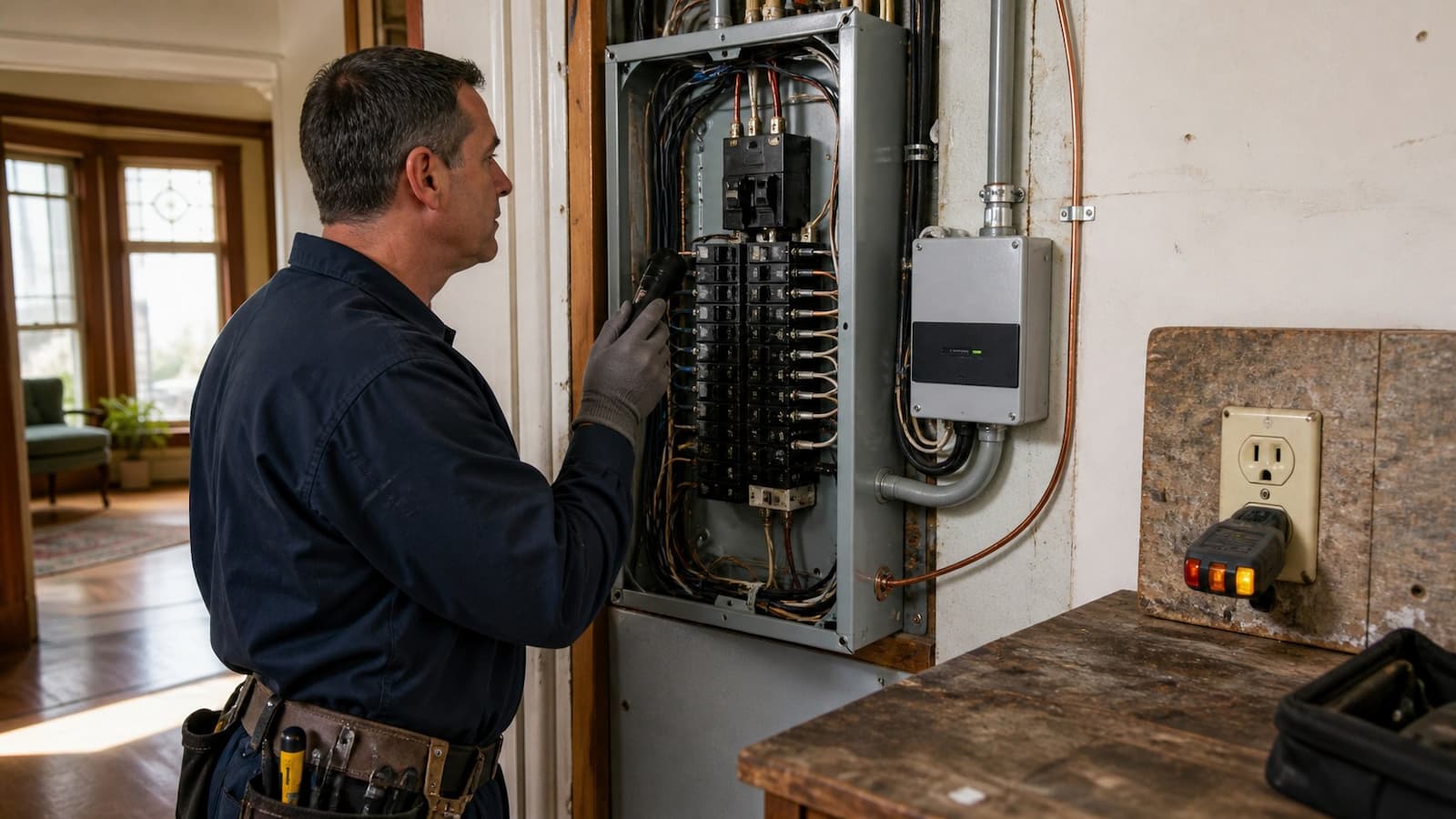
A surge-protection power strip may light up when it is plugged into an ungrounded outlet. That does not prove it can provide the protection printed on the package. Many plug-in surge protectors rely on a functional equipment-grounding path to divert excess voltage. Original knob-and-tube branch circuits generally do not include that path.
The result is easy to misunderstand. The strip may still distribute power. Its switch may work, and one indicator may glow. Yet its surge response can be reduced or unpredictable, while the missing equipment ground remains a separate shock-safety problem. A three-to-two-prong adapter does not create a ground.
For a San Francisco home with mixed old and new wiring, the best solution often has two layers: correct the circuits serving sensitive equipment and have an electrician evaluate a properly installed surge protective device at the service or panel. Neither layer should be used to excuse unsafe knob-and-tube.
A Power Strip and a Surge Protector Are Not the Same
A basic power strip adds receptacles. A surge protector contains components intended to limit brief voltage spikes before they reach connected electronics. The two can look nearly identical, so the product label and listing matter.
Many common protectors use metal-oxide varistors, or MOVs, between combinations of line, neutral, and ground. When voltage rises above the device’s threshold, those components conduct and route surge energy away from the protected load. The equipment ground is part of that strategy for standard three-wire products.
Eaton’s consumer guidance states that a standard AC surge protector requires a functional ground connection to work properly. It also notes that a “Protected” indicator and a “Grounded” or fault indicator do not communicate the same thing. Read the manufacturer’s explanation of how plug-in surge protectors work.
What Is Missing on a Knob-and-Tube Branch Circuit?
Original knob-and-tube systems use separate hot and neutral conductors. They predate the modern equipment-grounding conductor run with branch-circuit wiring. That does not mean the home has no grounding electrode system at the service; it means the old branch usually does not carry a dedicated fault-current path to each outlet and device box.
This distinction matters:
| Term | Purpose | What K&T commonly provides |
|---|---|---|
| Neutral | Normal return path for operating current | Yes, as one of the two circuit conductors |
| Equipment ground | Low-impedance fault path that bonds exposed metal | Generally no |
| Grounding electrode system | Connects service equipment to earth and other required electrodes | May exist at the service even when old branches are ungrounded |
| GFCI protection | Trips when current leaving and returning differs | Can be added in allowed configurations, but does not create a ground |
Neutral and ground meet only where the electrical system is designed to bond them. They are not interchangeable at a receptacle. Connecting a surge protector or appliance ground to neutral downstream can put normal current on metal enclosures and create a shock hazard.
Why the Lights on the Strip Can Mislead You
Indicator labels vary. A light marked “Power” may show only that voltage is present. “Protected” may indicate that internal surge components have not failed. “Grounded” or “Wiring Fault” may report a missing ground or another common wiring condition. Some testers cannot detect every defect, and an old or inexpensive strip may offer little useful diagnosis.
If the strip reports no ground, do not defeat the warning with an adapter. APC’s grounding guidance explains that its surge and UPS products may appear to operate without a ground, but the company does not support ungrounded use because of shock, signal, and unpredictable-operation concerns. The manufacturer also warns against breaking off the ground pin or using an adapter to interrupt grounding. See APC’s product-grounding requirements.
Does GFCI Protection Make a Surge Protector Work?
No. A GFCI and a surge protective device solve different problems. A GFCI compares current on the circuit conductors and trips when it detects an imbalance that may indicate current is flowing through a person or another unintended path. It does not add an equipment-grounding conductor.
In certain code-compliant replacements, a GFCI receptacle or GFCI-protected three-prong receptacle may be installed on an ungrounded circuit with required labels. That can improve shock protection. The label “No Equipment Ground” is not decorative; it tells you the outlet still lacks the grounding path on which many plug-in surge protectors rely.
GFCI protection is valuable, but it does not turn an ungrounded branch into a grounded surge-protection circuit.
Can a Whole-House Surge Protective Device Help?
A listed surge protective device installed at the service equipment or panel can limit surges entering or moving through the home’s electrical system. It is not dependent on a ground wire at one wall outlet in the same way a plug-in strip is. It does, however, depend on correct installation, short conductor paths where specified, sound service grounding and bonding, and a panel compatible with the device.
Whole-house protection can be worthwhile in a property with mixed-era wiring, but it does not repair cracked insulation, open splices, overloaded branches, or missing equipment grounds at receptacles. It also cannot guarantee survival of a direct lightning strike or every utility event.
Ask an electrician to evaluate the service before selecting equipment. Our whole-house surge protection service in San Francisco covers the installation side of this option.
Why Layered Protection Is Better
Surges can enter through utility power, but sensitive equipment may also connect to coaxial, telephone, Ethernet, or outdoor conductors. Protection is most effective when the paths are considered together.
- Service or panel protection reduces surge energy at the electrical entrance.
- Grounded point-of-use protection adds a second layer close to computers, televisions, and networking equipment.
- Protected communications paths help prevent a surge from bypassing the AC protection through coaxial or data cables.
- Correct grounding and bonding gives protective devices the reference and fault paths their designs require.
For a home office on an active knob-and-tube branch, the practical priority is usually a new grounded circuit. That gives expensive electronics a modern receptacle, correct equipment ground, suitable circuit capacity, and a reliable place for point-of-use protection.
What Not to Do
- Do not cut off the ground pin. The plug configuration communicates a safety requirement.
- Do not assume a three-prong adapter creates grounding. Its grounding tab works only when connected to a verified grounded box by an allowed method.
- Do not bond neutral to ground at the outlet. This creates an improper downstream connection.
- Do not daisy-chain strips. More receptacles increase the temptation to overload an old branch, and manufacturers generally prohibit or discourage this setup.
- Do not run high-load appliances from a strip. Space heaters, portable air conditioners, and similar loads belong on suitable circuits and receptacles, not crowded power strips.
- Do not treat a surge protector as an electrical repair. It cannot correct deteriorated wiring.
A Sensible Upgrade Plan
- Identify the circuits. Determine which receptacles are on knob-and-tube and which are supplied by newer grounded wiring.
- Test grounding properly. A licensed electrician should verify the continuity and condition of grounding and bonding rather than infer it from the receptacle face.
- Prioritize sensitive and essential equipment. Create modern grounded circuits for the home office, networking equipment, television system, and other valuable loads.
- Evaluate panel-level protection. Select a listed device compatible with the service or panel and install it under the required permit.
- Add point-of-use protection where the branch is grounded. Follow device instructions and monitor status indicators.
- Replace protectors after end-of-life indications or significant events. MOV-based products wear as they absorb surges.
If the home contains mostly two-prong receptacles, begin with our guide to what two-prong outlets reveal about older wiring. The receptacle face is a clue, not a complete diagnosis.
Frequently Asked Questions
Will a surge protector work in a two-prong outlet with an adapter?
Not as intended unless the adapter is connected to a verified grounding path in a manner allowed for the installation. In a typical ungrounded knob-and-tube box, the adapter does not create the missing path. Do not defeat a three-prong plug to make it fit.
If the “Protected” light is on, am I safe?
Not necessarily. That light may report the condition of internal components, not the presence of a correct equipment ground. Check every indicator and the product manual.
Does a GFCI outlet add surge protection?
No. A GFCI is designed primarily to reduce shock risk by detecting current imbalance. It does not add an equipment ground or perform the same function as a surge protective device.
Can I install a whole-house SPD while knob-and-tube remains?
Possibly, if the service, panel, grounding, bonding, and installation meet the device and code requirements. The electrician should inspect the system. The SPD will not make unsafe branch wiring safe.
What is the best protection for a computer on a K&T circuit?
A new, correctly grounded circuit is the strongest foundation. It can then support a suitable point-of-use surge protector or UPS according to the manufacturer’s instructions, ideally as part of a layered plan that includes panel-level protection.
Choose the Circuit Before the Protector
A plug-in surge protector should not be trusted on an ungrounded knob-and-tube outlet merely because it supplies power. Correct the branch circuits that serve valuable electronics, verify the home’s grounding and bonding, and consider a listed panel-level device as part of a layered design. Surge protection works best when the electrical paths are intentional and testable.