
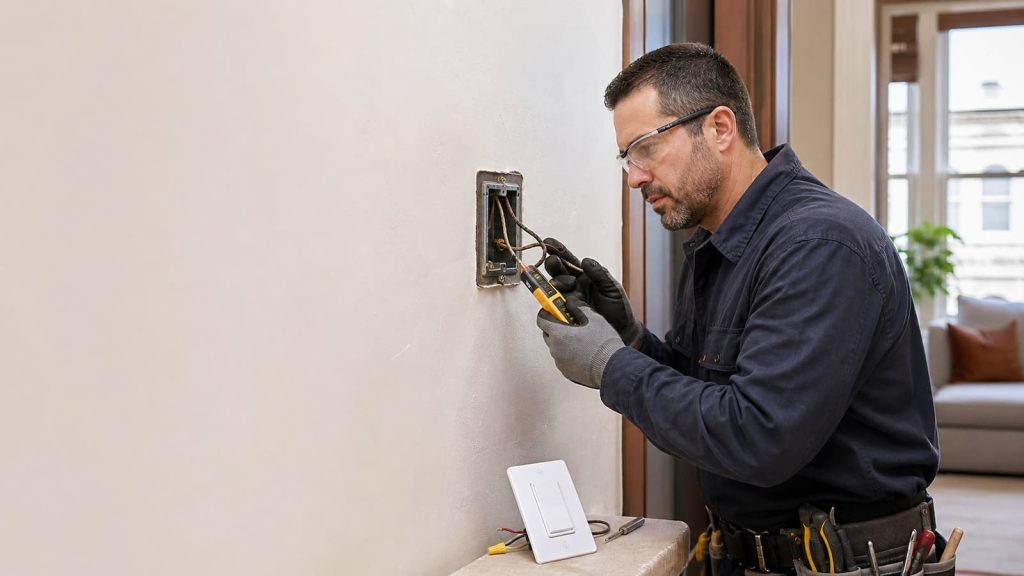
A smart switch can fit neatly into a century-old San Francisco wall box. That does not mean it can work safely with the wiring inside. Most smart controls need a steady trickle of power for their radio and electronics, even when the light is off. Many knob-and-tube switch loops provide only a line conductor and a switched conductor at the box—no neutral and usually no equipment ground.
Some products are designed for boxes without a neutral. A smaller group may still require an earth-ground connection, a companion bridge, particular lamp types, or minimum and maximum loads. Those details make “buy a no-neutral switch” an incomplete answer for a knob-and-tube home.
The right path is to identify the conductors, verify the circuit and box, read the exact device instructions, and decide whether a new modern cable is a better investment. Never rely on wire color alone, and never use a ground as a substitute for a neutral.
Why Ordinary Smart Switches Need a Neutral
A basic mechanical switch simply opens or closes the path to the light. It does not need to run a Wi-Fi radio, indicator LED, processor, or occupancy sensor. A smart switch does. Many models use the neutral conductor to complete a small power circuit for their electronics while the controlled light remains off.
Modern wiring commonly brings line, load, neutral, and equipment grounding conductors into the switch box. Older homes often do not. A traditional switch loop may carry power down to the switch on one conductor and return switched power to the fixture on the other. The neutral stays at the ceiling outlet. From the face of the switch, both systems can look identical.
| Conductor or part | What it does | Why it matters to a smart switch |
|---|---|---|
| Line | Brings energized power to the control | Required by the device |
| Load | Carries switched power to the light | Required by most in-wall controls |
| Neutral | Provides the normal return path | Required by many smart switches |
| Equipment ground | Provides a fault-current path and bonds metal parts | Required for safety and by some no-neutral products |
| Traveler conductors | Connect multi-location controls | Device-specific in three-way and four-way circuits |
Why Knob-and-Tube Switch Boxes Are Unpredictable
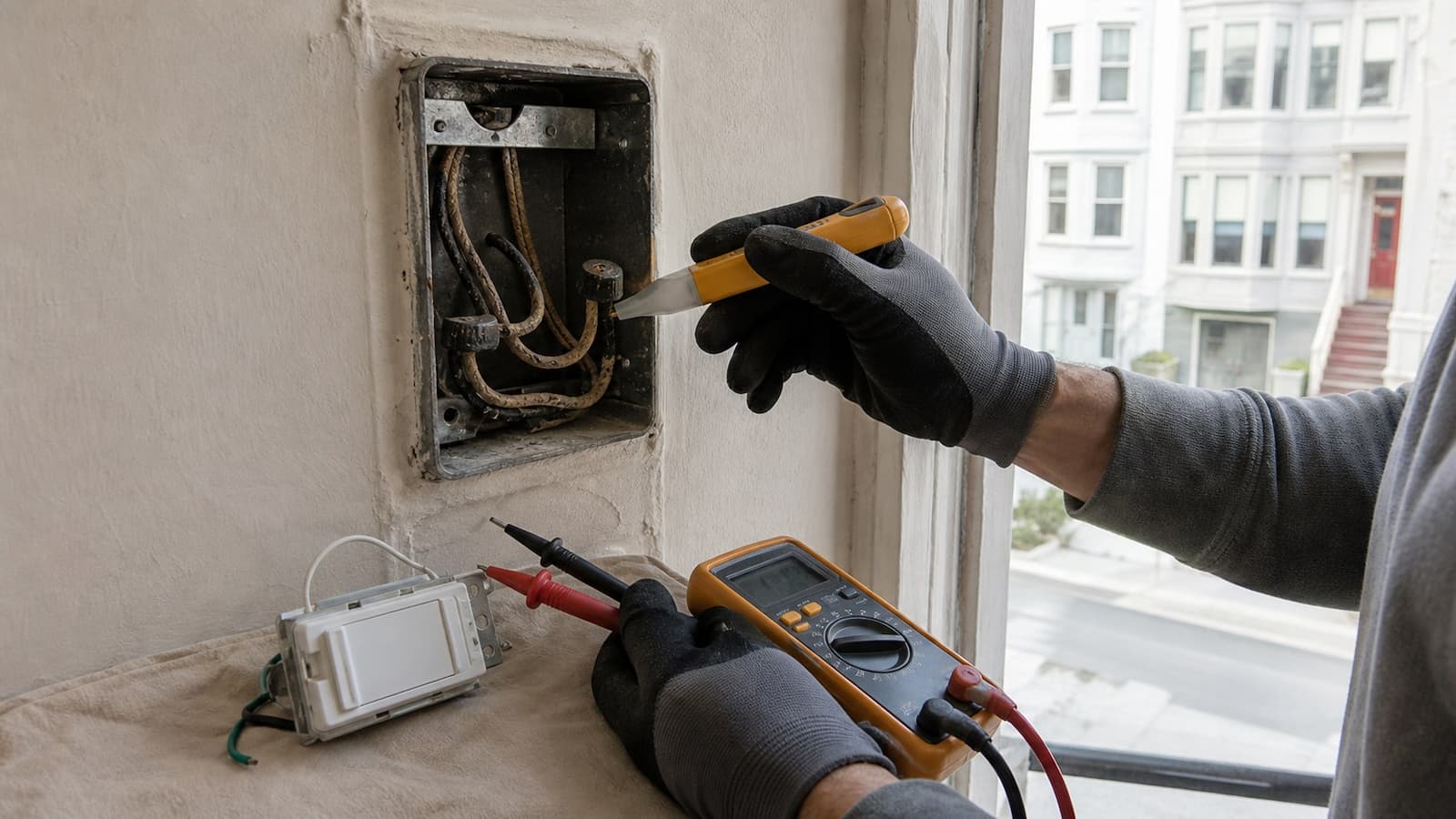
Knob-and-tube conductors were run separately rather than bundled in modern cable. Over many decades, electricians and homeowners may have replaced fixtures, extended branches, added boxes, or reused conductors in ways that are not obvious from the wall plate. A box can contain original cloth-insulated wire, later thermoplastic wire, or a splice between the two.
Common surprises include:
- No neutral conductor at the switch.
- No equipment-grounding conductor.
- A metal box that is not actually grounded.
- Brittle insulation that cracks when the switch is pulled forward.
- A shallow box with too little room for a deep electronic control.
- Line and load conductors whose colors no longer identify their function.
- A three-way circuit that does not match the smart device’s supported configuration.
- A shared neutral or mixed circuit created during a later alteration.
If the insulation breaks during inspection, the project is no longer a simple device swap. The damaged portion must be made safe, and replacement may require access beyond the switch opening.
No-Neutral Does Not Mean No Requirements
No-neutral smart controls use other engineering methods to power their electronics. Some pass a very small current through the lighting load; others work with a separate bridge or companion component. Compatibility depends on the specific product and lamp.
For example, Leviton markets no-neutral controls for older homes, but its published installation information for the DN-series switch and dimmer requires line, load, and earth-ground connections, along with a Wi-Fi bridge for smart connectivity. The company tells users without an available ground to consult technical support or an electrician. This is a useful reminder that “no neutral” does not mean “works with any two wires.” See the manufacturer’s smart-lighting guidance and the instructions for the exact product under consideration.
Other manufacturers may use different designs. Read the current installation sheet rather than relying on a retailer’s filter or a product name. If the instructions call for a neutral or earth ground, that conductor must be present and verified. A workaround invented at the box is not a substitute.
A Metal Box Is Not Proof of Grounding
Some older switch boxes are metal. Homeowners often assume the mounting screws make them grounded. The box is grounded only if there is a continuous, effective bonding path back to the service equipment. Original knob-and-tube wiring generally does not provide an equipment-grounding conductor.
A later metal raceway or grounding conductor may bond the box, but it must be tested. Attaching a device’s green lead to an ungrounded metal box accomplishes nothing. Connecting that lead to a neutral is dangerous and improper because normal return current can energize metal parts.
If the project needs a reliable equipment ground, ask about a new grounded circuit or a properly designed grounding and bonding solution. Our San Francisco grounding and bonding service explains the broader system.
Lamp Compatibility Can Make or Break the Installation
A no-neutral control may depend on a small current passing through the lamp when it appears off. With some LED drivers, that can cause ghosting, a faint glow, flicker, delayed shutoff, or unstable dimming. Low-wattage loads are particularly sensitive. A manufacturer-approved bypass or load adapter may solve a supported condition, but only when installed according to the product instructions—often at the fixture, where a neutral is available.
Before buying a smart dimmer, check:
- The lamp type: dimmable LED, incandescent, magnetic low-voltage, electronic low-voltage, or another listed load.
- The total wattage and the device’s minimum and maximum ratings.
- Whether the exact bulbs appear on the manufacturer’s compatibility list.
- Whether a bypass is permitted and where it must be installed.
- Whether the device supports the existing three-way arrangement.
Do not exceed the control’s rating simply because the old switch handled the lights. Electronic dimmers have their own heat and derating rules, especially when several devices share a multi-gang box.
Three-Way Circuits Need Extra Attention
In a conventional three-way circuit, either switch can control the light. The two boxes may not contain the same conductors. One may have line power, the other the switched leg, with travelers between them. Older work can be even less predictable.
Smart-control systems handle multi-location switching in different ways. Some need a smart master and a wired companion. Some reuse travelers. Others pair a wall control with a battery-powered remote. Before ordering, the electrician should identify which box has line, load, neutral, ground, and travelers. Buying two identical smart switches is not automatically the answer.
Four Practical Upgrade Paths
1. Install a listed no-neutral control on a verified compatible circuit
This can work when the product supports the lamp, box, grounding condition, wiring arrangement, and load. It is the least invasive option, but it should not be used to hide deteriorated conductors or a questionable splice.
2. Pull a new cable to the switch box
A modern cable can provide neutral and grounding along with the necessary switched conductors. Access may be possible from an attic, basement, closet, or small plaster opening. This route gives more device choices and often produces a cleaner long-term result.
3. Rewire the lighting circuit
If the fixture and switch conductors are brittle or the circuit contains problematic alterations, replacing the branch may make more sense than solving one box. Plan fixture boxes, switch locations, neutral availability, grounding, arc-fault protection, and future controls together.
4. Use smart lamps or wireless controls without altering the old switch wiring
A smart bulb can be a temporary solution when the existing switch remains on. Wireless scene controllers may provide convenient wall control without placing a powered smart device in the legacy box. This does not repair old wiring, and household members can defeat the automation by turning off the mechanical switch, but it can avoid an unsuitable device swap.
What the Electrician Should Check
- Whether the circuit is actually knob-and-tube, newer cable, raceway, or a mixture.
- Which conductor is line, load, neutral, ground, and traveler.
- Whether the box is grounded and large enough for the listed conductors and device.
- Whether the old insulation can be handled without cracking.
- Whether splices are enclosed, accessible, and suitable.
- Whether the breaker or fuse correctly protects the conductors.
- Whether the product is listed for the lamp type, wattage, and multi-location arrangement.
- Whether the alteration requires a permit or additional code upgrades.
A plug-in tester cannot answer most of these questions at a switch box. Even a voltage reading can be misleading when conductors are misidentified or a meter senses induced voltage. This is a small device with a potentially broad diagnostic scope.
Stop and Reconsider the Device Swap If…
- Cloth insulation flakes or cracks when touched.
- The box contains an open or taped splice with no listed connector.
- The switch or wall plate is warm or discolored.
- A neutral has been borrowed from another circuit.
- The device requires a ground and none can be verified.
- The smart control flickers, buzzes, resets, or leaves the lamp glowing.
- The deep device must be forced into a crowded shallow box.
Turn off the circuit and have it evaluated. Forcing brittle conductors into the back of the box can turn a convenience upgrade into an insulation failure.
Frequently Asked Questions
Can a smart switch work with only two wires?
Some listed no-neutral products are designed for certain two-conductor switch-loop situations, but their other requirements still apply. A device may require earth ground, a bridge, a compatible lamp, or a particular wiring arrangement. Identify the circuit before choosing the product.
Can I connect the neutral terminal to ground?
No. Neutral and equipment grounding have different functions in branch-circuit wiring. Using ground as a normal return path can energize metal parts and create a shock hazard.
Does a metal switch box give me a ground?
Only if the box has a verified continuous bonding path back to the electrical system. Its material and age do not prove that path exists.
Will a no-neutral dimmer damage LED bulbs?
A properly matched listed control should operate within its instructions, but incompatible LEDs can flicker, glow, buzz, or perform poorly. Check the manufacturer’s bulb list, wattage range, and bypass instructions.
Is a permit required to replace a switch in San Francisco?
Permit treatment depends on the exact repair or alteration. Adding wiring, replacing boxes, creating new circuits, or expanding the scope can change the answer. Ask a licensed San Francisco electrical contractor or DBI about the planned work.
The Best Smart-Home Upgrade May Be New Wiring
A compatible no-neutral control can be useful when a legacy circuit is in sound condition and every product requirement is satisfied. It should not be treated as a universal adapter for knob-and-tube. If the box lacks ground, the insulation is fragile, or several rooms are getting smart controls, a modern grounded lighting circuit with neutrals at the switches gives the home a safer and more flexible foundation. For help with the device and fixture side of the project, see our light fixture and switch replacement service.