
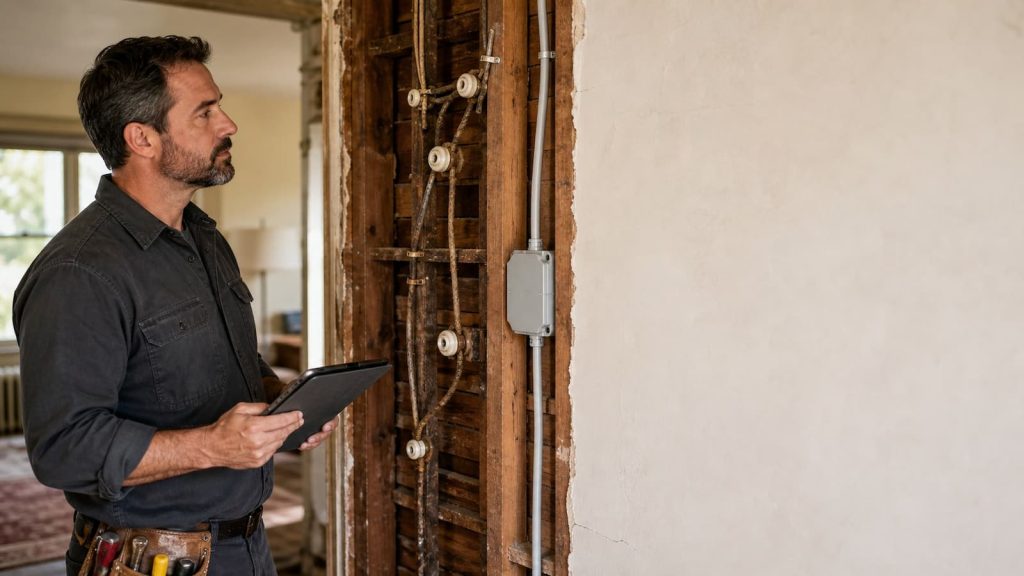
Knob-and-tube wiring is not automatically illegal simply because it remains inside an older California home. That short answer, however, leaves out the part that matters: an existing installation, a new installation, a remodel, an insulation project, and an unsafe repair are treated very differently.
A century-old circuit may continue to serve a room without triggering an automatic statewide removal order. The same circuit may become a code, permit, insurance, or project-design problem once someone extends it, covers it with insulation, adds loads, opens the walls, or discovers damaged conductors. Local building officials also decide how adopted codes apply to the facts in front of them.
For San Francisco homeowners, “Is it legal?” is therefore only the first question. The useful questions are whether the wiring is active, safe in its present condition, permitted for the proposed work, compatible with the renovation, and acceptable to the people who must approve or insure the property.
Existing Wiring Is Not the Same as New Work
Electrical codes mainly govern how electrical work is installed, altered, repaired, and inspected. They do not make every older system disappear on the day a newer code edition takes effect. That is why many California homes still contain wiring methods that would not be chosen for a new house today.
Still, age does not grant blanket permission. Existing wiring must be maintained safely, and new work must follow the code and permit requirements that apply when the work is performed. San Francisco’s current electrical provisions require electrical wiring and equipment to be maintained in a safe condition. The City may also require correction when permitted work exposes unsafe conditions or when an installation has been altered unlawfully.
| Situation | What “legal” usually means in practice | Next step |
|---|---|---|
| Untouched, active K&T in an older home | Not automatically banned, but condition and use still matter | Have it evaluated if its status or safety is uncertain |
| New knob-and-tube installation | Not a normal permitted wiring choice; California code sharply limits new use | Use a current approved wiring method |
| New cable tied into old K&T | Transition, box, conductor condition, grounding, loading, and permit scope must comply | Have a licensed electrician review the actual connection |
| K&T in a cavity being insulated | Specific code restrictions and local procedures may apply | Resolve wiring before insulation |
| Damaged or overheating K&T | An unsafe condition is not protected by age | De-energize as needed and repair or replace under permit |
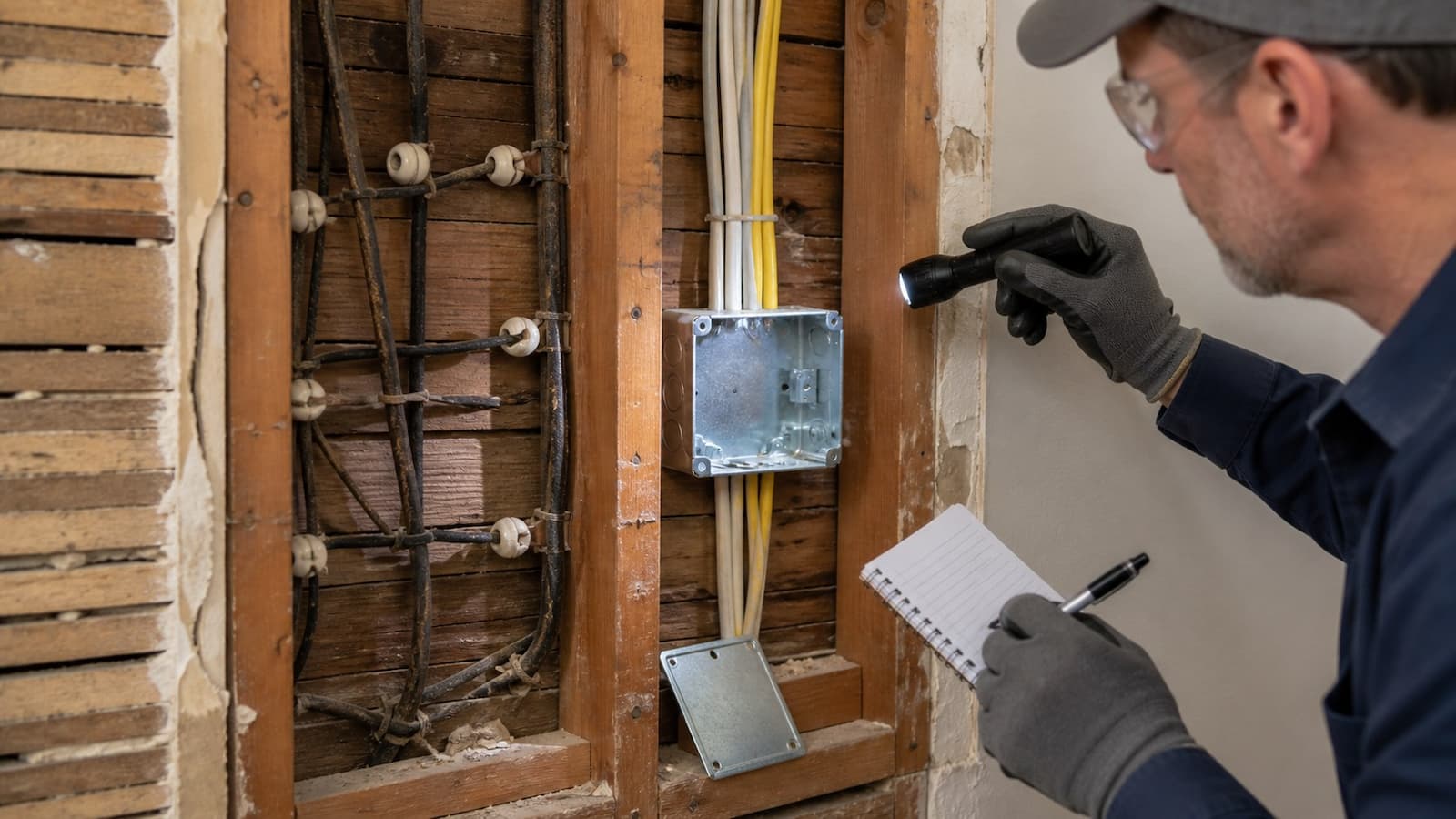
Why Homeowners Hear Conflicting Answers
One electrician says the system is “grandfathered.” Another recommends full replacement. An insurance agent says the carrier will not write the policy. A general contractor says the wiring can stay because the remodel does not touch it. Those statements may describe four different standards rather than one simple legal rule.
- The electrical code addresses installation and safety requirements.
- The permit authority interprets the adopted code for the project and property.
- An insurer applies private underwriting rules and may be stricter than minimum code.
- A lender, buyer, or HOA may impose contractual or transaction requirements.
- An electrician evaluates whether the system can safely support the home’s actual loads and planned work.
A circuit can avoid an immediate code-removal order and still be a poor candidate for continued service. It can also be electrically functional while failing an insurer’s eligibility rule. Asking each person what standard they are applying usually clears up the apparent contradiction.
California Restricts New Uses of Knob-and-Tube
California’s adopted electrical rules address concealed knob-and-tube wiring as a recognized legacy method, but not as an all-purpose choice for modern construction. One California building department, the City of Menlo Park, summarizes the issue plainly: new knob-and-tube installation is no longer allowed by the California Electrical Code except by special permission from the building official. Its guidance also points to the rule against using concealed knob-and-tube in insulated hollow spaces where insulation envelops the conductors.
That Menlo Park guidance is not a San Francisco permit decision. It is useful because it shows how one California authority applies the state electrical framework. In San Francisco, the Department of Building Inspection is the authority to consult for a local project.
The practical takeaway is straightforward: do not ask a contractor to reproduce, expand, or improvise knob-and-tube as though it were ordinary new wiring. When a renovation needs new outlets, lighting, appliance circuits, or controls, design those additions with current approved wiring methods and the required protection.
When Existing Knob-and-Tube Becomes a Permit Issue
You extend or alter the circuit
Adding a receptacle, relocating a switch, installing recessed lights, or connecting new cable to an old branch is electrical work. The transition cannot be treated as a casual splice hidden behind plaster. Box fill, accessibility, conductor condition, overcurrent protection, grounding, and the permitted scope all come into play.
The remodel exposes an unsafe condition
Opening a ceiling may reveal bare splices, brittle insulation, scorch marks, overfusing, or new cable attached to an unsuitable old connection. Closing the cavity without addressing a known hazard is not a sensible reading of “existing wiring can remain.” The electrician and inspector need a safe, inspectable resolution.
You add insulation
Traditional knob-and-tube relied on open air around individual conductors. Insulation that surrounds active conductors changes the thermal conditions and is specifically restricted. Do not assume an insulation contractor’s visual check replaces electrical testing and local approval. Plan the electrical work first.
You increase the electrical demand
A kitchen remodel, heat pump, induction range, electric dryer, EV charger, or home office can expose limitations that were not obvious when old circuits served a few lamps. The new equipment usually needs dedicated modern circuits; it should not be made to depend on a fragile legacy branch.
The work affects multiple units or common areas
Multi-unit properties add permit boundaries, shared equipment, tenant access, and ownership documents. A branch circuit may begin in a common panel and serve one unit, or pass through common framing before reaching private space. That arrangement needs more planning than a single-family room repair.
What “Grandfathered” Does—and Does Not—Tell You
People use “grandfathered” as shorthand for an older installation that is not required to be rebuilt solely because today’s code is different. The word is often too blunt for a real electrical decision.
It does not prove that:
- The original work was lawful or has never been altered.
- The insulation on the conductors remains sound.
- The circuit is correctly fused or protected.
- Every splice is enclosed and accessible.
- A three-prong receptacle is actually grounded.
- The wiring can be covered with insulation.
- An insurer must accept it.
- The system may be expanded during a new project.
Use the word only as the beginning of the discussion. The condition of the circuit and the proposed scope matter more.
A New Panel Does Not Legalize Everything Downstream
Many San Francisco homes have a modern breaker panel feeding a mixture of new cable and old knob-and-tube. Panel replacement can improve capacity and overcurrent protection, yet it does not replace the branch wiring hidden in walls. It also does not prove that old circuits were disconnected correctly.
Likewise, a three-prong outlet does not establish an equipment-grounding path. It may be properly supplied by modern grounded wiring, GFCI-protected and labeled under an allowed method, or simply installed as a cosmetic swap. Read our explanation of two-prong and three-prong outlets in older San Francisco homes for the distinctions.
How San Francisco Homeowners Should Verify the Answer
- Define the question. Are you asking about leaving an untouched circuit, adding insulation, remodeling a room, satisfying an insurer, or selling the property?
- Map what is active. An electrician should determine which lights and receptacles remain on knob-and-tube and where newer wiring begins.
- Inspect accessible condition. Look for damaged insulation, exposed splices, heat, moisture, pest damage, and inappropriate extensions.
- Review the permit history. Records can show completed work, but absence of a record does not prove that nothing was changed.
- Ask DBI about the proposed scope. General internet answers cannot bind the local inspector assigned to a specific permit.
- Get separate insurance guidance. Code acceptance does not compel a private carrier to insure the risk.
If replacement is required, the project should be permitted and documented. Our guide to electrical rewire permits in San Francisco explains the homeowner-facing process.
Legal to Keep Does Not Mean Sensible to Ignore
A lightly loaded, unaltered circuit in accessible space presents a different decision from brittle conductors buried under insulation and feeding a remodeled kitchen. The label “knob-and-tube” does not capture that difference. Neither does the word “legal.”
Replacement becomes more urgent when an inspection finds damaged insulation, open splices, incorrect overcurrent protection, heat damage, insulation contact, ungrounded receptacles serving equipment that needs grounding, or extensive undocumented additions. Planned electrification can also make replacement practical even before a failure occurs, because the walls will already be open and new circuits are needed.
If the wiring appears stable and the immediate project does not disturb it, ask the electrician to document limitations and a future replacement plan. That gives the owner a real decision instead of a yes-or-no slogan.
Frequently Asked Questions
Is knob-and-tube wiring banned in California homes?
Existing knob-and-tube is not automatically unlawful merely because it is old. New installation and alterations are a different matter, and unsafe conditions may require correction. The local building authority determines how the adopted code applies to a specific project.
Can I add a new outlet to an existing knob-and-tube circuit?
Do not assume so. The work is an alteration, and the electrician must evaluate the old conductors, circuit loading, grounding needs, transition method, protection, and permit requirements. A new modern circuit is often the cleaner solution.
Can San Francisco make me replace it during a remodel?
The answer depends on the permitted scope and conditions uncovered. Work within the remodel area must comply, and known unsafe conditions cannot simply be concealed again. Ask DBI and the project electrician before finalizing plans.
Does a passed home inspection prove the wiring is code-compliant?
No. A home inspection is generally visual and noninvasive. It is not the same as circuit tracing by an electrician or an approval issued through the City’s permit inspection process.
Will a permit guarantee that my insurer accepts knob-and-tube?
No. Permitting and insurance underwriting are separate systems. Ask the carrier what evidence it wants before choosing a repair or replacement scope.
What This Means for Your House
Knob-and-tube wiring can remain in some California homes without being automatically illegal, but that statement is not permission to extend it, bury it in insulation, ignore deterioration, or assume it will survive a remodel review. Confirm what is active, judge its condition, match the electrical plan to the proposed work, and get the local permit answer in writing when the scope is significant.
This article provides general educational information, not a project-specific code ruling or legal opinion. Codes, local interpretations, and permit requirements can change.