
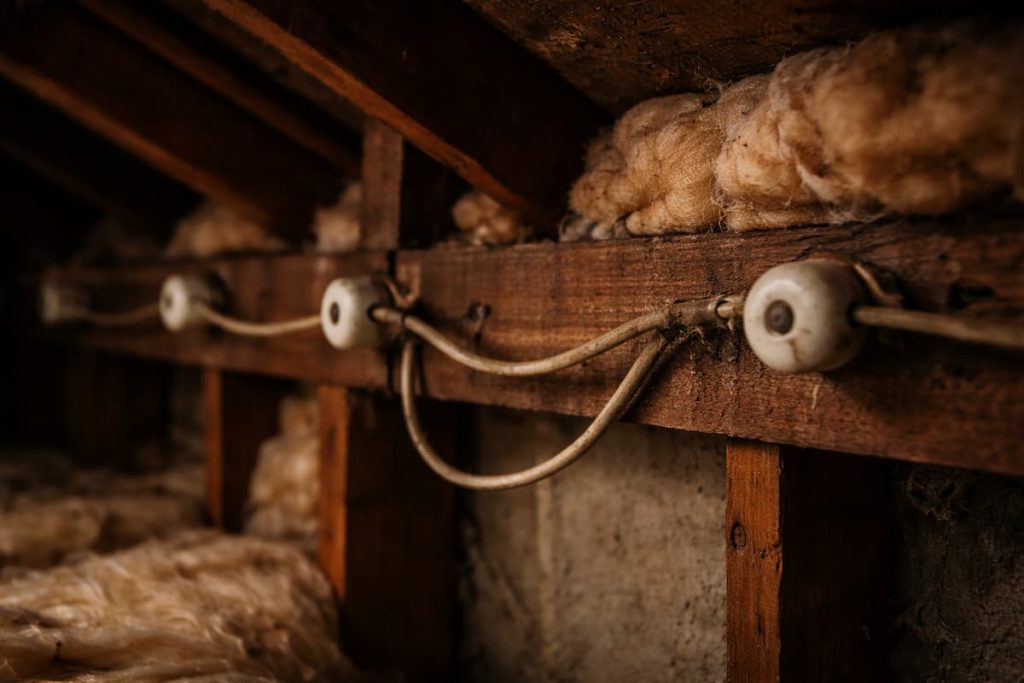
It’s one of the most common questions homeowners ask after discovering knob-and-tube wiring in their house: Is this actually dangerous—or just outdated?
The honest answer sits somewhere in the middle. Knob-and-tube wiring, by itself, is not inherently a ticking time bomb. In fact, when it was installed correctly and left undisturbed, it was considered a safe system for its time. But homes change. Electrical demand changes. And wiring that once worked quietly in the background is often asked to do far more than it was ever designed for.
In San Francisco, where many homes are over 80–100 years old, the issue is rarely just “knob-and-tube vs modern wiring.” It’s usually a mix of aging materials, partial upgrades, insulation changes, and decades of modifications—some careful, some not.
This is where fire risk enters the conversation.
This article breaks down what actually causes electrical fires in homes with knob-and-tube wiring, which conditions increase the risk, and how to tell whether your system is still functioning safely—or quietly approaching failure.
Understanding Knob-and-Tube Wiring in Context
Before discussing fire risk, it’s important to understand how knob-and-tube (K&T) wiring was designed to function.
How the system works
Knob-and-tube wiring uses:
- Individual conductors (hot and neutral run separately)
- Ceramic knobs to secure wires along framing
- Porcelain tubes to protect wires passing through wood
- Air spacing between wires to allow heat to dissipate
This design had one major advantage: heat control. Because wires were not bundled together and were suspended in open air, they could cool naturally.
What’s missing compared to modern wiring
Modern electrical systems include features that K&T does not:
- Grounding conductors
- Insulated cable sheathing (Romex)
- Circuit breakers designed for modern loads
- AFCI and GFCI protection
These differences don’t automatically make K&T dangerous—but they do reduce the margin for error under modern conditions.
Can Knob-and-Tube Wiring Cause a Fire? The Real Answer
Yes—knob-and-tube wiring can contribute to a fire under certain conditions.
But the cause is almost never “the system exists.” It’s usually one or more of the following:
- Overheating due to increased load
- Degraded insulation exposing conductors
- Improper modifications or splices
- Contact with insulation or combustible materials
- Loose or deteriorated connections causing arcing
Understanding these conditions is far more useful than simply labeling K&T as “safe” or “unsafe.”
The Most Common Fire Risk Factors in Knob-and-Tube Systems
1. Overloaded Circuits (The Most Common Issue)
Why it happens
Knob-and-tube wiring was designed for:
- Lighting circuits
- Minimal appliance use
Today, the same circuits may support:
- TVs, computers, and networking equipment
- Space heaters
- Kitchen appliances
- Window AC units
What changes over time
As electrical demand increases:
- Wires carry more current than intended
- Heat builds up
- Insulation degrades faster
Why this leads to fire risk
Excess heat is the primary driver of electrical fires. If a conductor consistently operates above its intended capacity, it can:
- Break down insulation
- Ignite nearby materials
- Cause hidden damage inside walls
2. Insulation Around Knob-and-Tube Wiring
A critical but often overlooked issue
Knob-and-tube wiring depends on open-air cooling.
When insulation (especially blown-in insulation) is added later:
- Heat becomes trapped
- Wires operate at higher temperatures
- Risk of overheating increases significantly
Common scenario in SF homes
Many San Francisco homes were retrofitted with attic insulation decades after construction. In some cases:
- Insulation is packed directly over K&T wiring
- No clearance is maintained
- Wiring is no longer visible or accessible
Why this matters
This condition doesn’t fail immediately—but it creates a long-term thermal problem that increases fire risk.
3. Aging and Deteriorated Wire Insulation
What happens over time
Original K&T wiring uses cloth or rubber insulation that:
- Dries out
- Becomes brittle
- Cracks or flakes away
What that leads to
When insulation fails:
- Conductors can contact wood framing
- Wires may touch each other
- Short circuits or arcing can occur
Why it’s dangerous
Electrical arcs can reach extremely high temperatures—enough to ignite nearby materials even without visible sparks.
4. Improper Splices and DIY Modifications
A very common issue in older homes
Over decades, homeowners and contractors may have:
- Extended circuits
- Added outlets
- Connected new wiring to old K&T
Not all of these modifications are done correctly.
Warning signs:
- Wires twisted together without a junction box
- Electrical tape used as the only protection
- Mixed wiring types without proper transitions
Why this increases fire risk
Modern electrical code requires:
- Enclosed junction boxes
- Secure connections
- Accessible splices
When these rules aren’t followed, the risk of overheating and arcing increases significantly.
5. Loose Connections and Electrical Arcing
What is arcing?
Arcing occurs when electricity jumps across a gap between conductors.
Causes:
- Loose terminals
- Worn connections
- Damaged conductors
Why it’s dangerous
Arcing generates:
- Extremely high temperatures
- Intermittent electrical faults
- Potential ignition points inside walls
Unlike steady overheating, arcing can happen suddenly and unpredictably.
6. Lack of Grounding
What grounding does
Grounding provides a safe path for electrical faults.
Knob-and-tube limitation:
- No grounding conductor
What this means:
- Fault currents may travel through unintended paths
- Increased shock risk
- Reduced effectiveness of modern surge protection
While lack of grounding alone doesn’t cause fires, it contributes to unsafe conditions when combined with other issues.
7. Rodent Damage and Physical Wear
Often overlooked
In attics and crawlspaces:
- Rodents may chew insulation
- Wires may be disturbed
- Physical damage accumulates
Result:
- Exposed conductors
- Increased chance of short circuits
8. Hidden Conditions Behind Walls
One of the biggest challenges with knob-and-tube wiring is that much of it is:
- Hidden
- Inaccessible
- Untouched for decades
This makes it difficult to assess without a professional inspection.
Table: What Increases Fire Risk vs What Doesn’t
| Condition | Fire Risk Level | Notes |
|---|---|---|
| Original K&T in good condition | Low–Moderate | Depends on load and environment |
| Overloaded circuits | High | Most common issue |
| Insulation covering wires | High | Prevents heat dissipation |
| Brittle or missing insulation | High | Direct exposure risk |
| Improper splices | Critical | Major hazard |
| Mixed old/new wiring | Medium–High | Depends on quality of connections |
| Lack of grounding alone | Medium | Increases risk indirectly |
Why This Is Especially Relevant in San Francisco Homes
San Francisco homes have a unique combination of factors:
1. Age and architecture
Victorian and Edwardian homes often:
- Still contain original wiring
- Have complex layouts
2. Renovation layering
Instead of full rewires, many homes have:
- Partial upgrades
- Mixed systems
- Legacy circuits still active
3. Limited access
- Tight crawlspaces
- Finished attics
- Difficult wall access
These factors make it more likely that:
- Issues go undetected
- Temporary fixes become permanent
Real-World Scenario: How Fires Typically Develop
It’s rarely a single failure.
A typical sequence might look like:
- Circuit load increases over time
- Insulation is added over attic wiring
- Wire insulation degrades
- A connection loosens
- Heat builds gradually
- Arcing begins intermittently
- Surrounding materials ignite
This process can take years—but when it reaches a critical point, failure happens quickly.
When Should Homeowners Be Concerned?
Immediate concern:
- Burning smell
- Hot outlets
- Visible damaged wiring
Moderate concern:
- Frequent breaker trips
- Flickering lights
- Mixed wiring systems
Lower urgency (but still important):
- Two-prong outlets
- Known presence of K&T without visible issues
What to Do If You Suspect a Problem
Step 1: Avoid DIY fixes
Temporary solutions often create new risks.
Step 2: Schedule a professional evaluation
A qualified electrician can:
- Identify active K&T circuits
- Assess load and condition
- Check for unsafe modifications
Step 3: Plan next steps
Depending on findings:
- Targeted repairs
- Partial rewiring
- Full system replacement
When Replacement Becomes the Right Decision
There’s no single rule—but replacement is often recommended when:
- Multiple warning signs are present
- The system can’t support modern usage
- Insulation or structural changes affect wiring
- You’re planning major upgrades
If you’re considering a full upgrade, you can learn more about the process and options on our
knob-and-tube wiring replacement services page.
Final Thoughts
Knob-and-tube wiring doesn’t cause fires simply by existing—but under the wrong conditions, it can become part of a larger problem.
The key is understanding those conditions:
- Heat
- Load
- Age
- Modifications
Most importantly, the warning signs are rarely hidden—they’re just easy to overlook.
If your home shows multiple indicators from this list, it’s not about reacting to fear. It’s about making informed decisions before small issues become serious ones.