
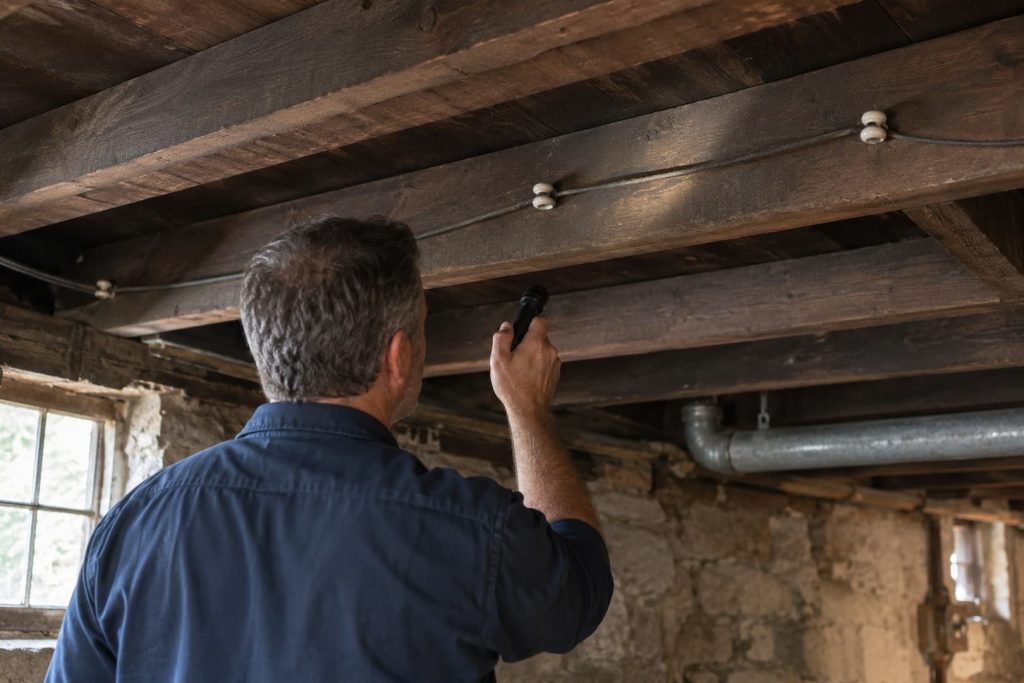
Cloth wiring and knob-and-tube wiring are not interchangeable terms. “Cloth wiring” describes a fabric covering you can see. Knob-and-tube describes how individual wires run through a building and how porcelain parts support them. A house can have cloth-covered knob-and-tube, cloth-sheathed cable, or both.
That distinction matters when an inspection report flags old wiring or an insurer asks what is still in service. A fuzzy brown covering does not tell you whether a circuit has a ground, whether its insulation is sound, or whether the wire still carries electricity. Those are separate questions. Start by identifying the wiring method, then have an electrician establish its condition and use.
The quickest way to distinguish the wiring
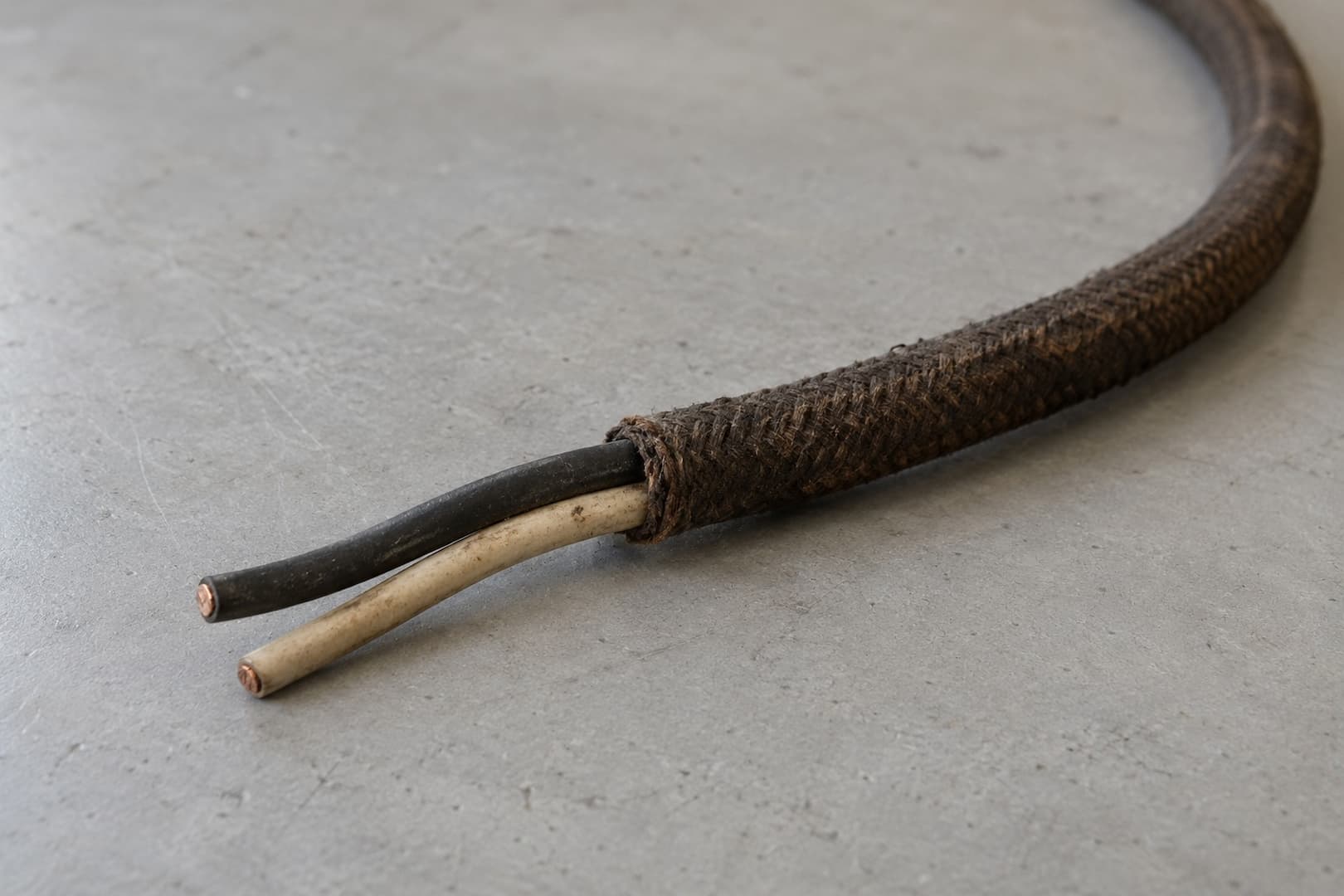
From a safe, accessible location, look at how the wires run. With knob-and-tube, the individual insulated conductors travel separately. With cable, several conductors share an outer covering. Porcelain knobs attached to framing and porcelain tubes through wood are characteristic clues for knob-and-tube. Leave insulation, wires, and electrical boxes undisturbed when taking photos for an electrician.
| What you can see | What it may indicate | What remains unconfirmed |
|---|---|---|
| Separate insulated wires supported on porcelain knobs, with porcelain tubes at framing penetrations | Knob-and-tube wiring | Whether it is active and where the complete circuit runs |
| One fabric-covered cable containing multiple insulated conductors | Older nonmetallic-sheathed cable, often called cloth Romex | Internal insulation condition and presence of an equipment ground |
| A flexible, spiral metal jacket | Armored cable or another metal-enclosed wiring system | Exact cable type and whether it provides a valid grounding path |
| A short cloth sleeve near a light fixture or box | Protective sleeving or a fabric-covered conductor | The wiring method farther back in the wall or ceiling |
| Empty porcelain knobs beside newer cable | Evidence of an earlier installation | Whether any other old branches remain energized |
What “cloth wiring” actually describes
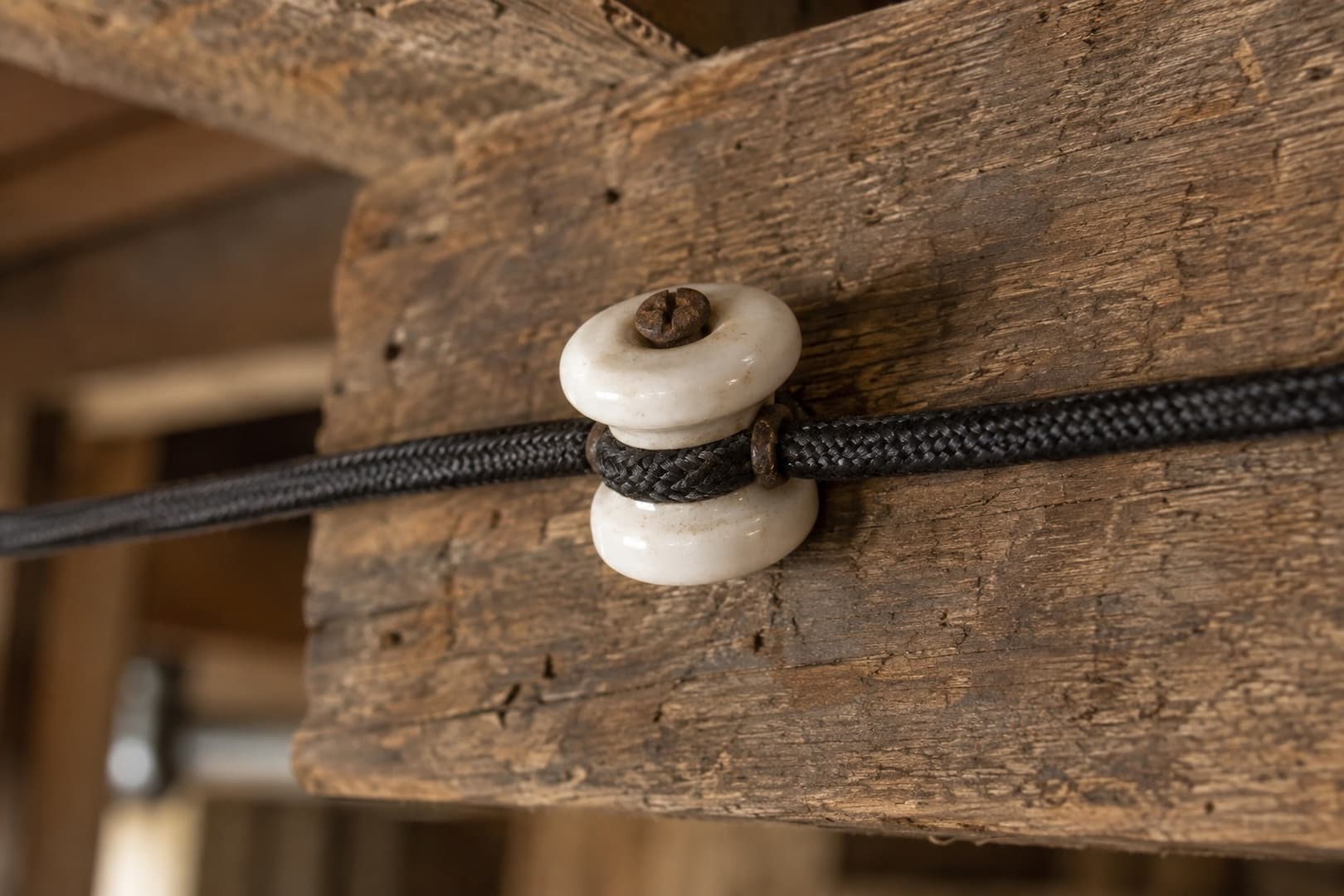
The phrase is informal. Someone may use it for the woven layer around an individual wire, the outer jacket around an entire cable, or protective sleeving where a conductor enters a fixture. Those coverings do different jobs, so a report that says only “cloth wiring present” leaves too much unanswered.
The U.S. Consumer Product Safety Commission’s history of residential wiring describes early nonmetallic cable as rubber-insulated conductors inside a treated woven cotton jacket. This is why an old cable can look like cloth on the outside without being knob-and-tube. The shared jacket is the important distinction.
“Cloth-insulated” and “cloth-sheathed” are also used loosely. The first usually refers to covering around a conductor; the second refers to an outer cable covering. Ask the person writing the report to identify which layer they mean. An electrician may need to inspect accessible terminations to answer that accurately. A homeowner should not strip a sample to settle the terminology.
Is cloth-covered Romex the same as knob-and-tube?
No. Romex is a brand name commonly used for nonmetallic-sheathed cable. The old cloth-covered version contains conductors together within a jacket. Knob-and-tube uses individually routed conductors. Calling both “old cloth wire” obscures a difference that affects inspection, grounding, and the replacement plan.
Do not use a cable’s age or cloth jacket alone to decide whether it has a ground. Older cable constructions vary. An intact-looking section in the basement also says little about the condition at a ceiling fixture, inside a box, or along a hidden route.
How knob-and-tube differs from cable
Knob-and-tube gets its name from two porcelain components: knobs hold wires away from framing, and tubes protect them where they pass through wood. The National Park Service’s description of these historic insulators also identifies flexible cloth sleeving, called loom, used where conductors entered devices or walls. A sleeve at one box is therefore only part of the picture.
Original residential knob-and-tube does not include an equipment-grounding conductor. Its hot and neutral conductors serve different functions from a modern ground wire. Adding a three-slot receptacle does not supply that missing grounding path, and neither does installing a newer breaker panel. The Carson Dunlop Home Reference Book distinguishes this ungrounded system from both later two-conductor cable and cable that includes a ground.
A house may contain several generations of wiring. A remodeled kitchen might have newer cable while hallway lights still connect to older branches. Identify what serves each area before treating one modern-looking section as evidence that the whole property was rewired.
What about cloth wires inside a metal jacket?
A spiral metal jacket points toward armored cable, often called BX, rather than knob-and-tube. Fabric-covered wires can exist inside that jacket. Whether the metal provides an acceptable equipment-grounding path depends on the identified wiring system, its construction, fittings, continuity, and condition.
For example, Southwire’s Type AC cable uses an armor-and-bonding-strip assembly as its grounding path. That product description does not establish that an unidentified older metal cable has the same construction. Ask for the grounding path to be verified. Our grounding and bonding service addresses this as part of the electrical assessment.
Does cloth wiring need to be replaced?
Seeing a cloth covering does not tell you how much wiring needs replacement. An electrician needs to establish which wiring is active, how much remains, and what condition it is in. Brittle insulation, damaged conductors, overheating, unsuitable alterations, and missing grounding where needed may change the recommendation. A planned renovation matters too, especially if it will disturb wiring that has remained untouched for decades.
Old rubber insulation can become brittle, especially where heat or mechanical damage has affected it. Bending a wire to see whether it cracks can cause the very damage you are trying to assess. Leave it in place. Replacement decisions should follow inspection of the actual installation, rather than a flexibility test by the homeowner.
Some concerns deserve prompt attention regardless of the wiring’s name. The Electrical Safety Foundation’s warning signs include repeated breaker trips, flickering lights, damaged insulation, unusual buzzing, heat discoloration, burning odors, and shocks. Stop using an affected outlet or switch and arrange an electrical evaluation. Smoke, visible arcing, or fire calls for leaving the area and contacting emergency services.
If the discovery comes during an attic project, pause before covering or disturbing old wiring. Added thermal insulation can change how wiring sheds heat. Have the electrical and insulation contractors resolve the existing conditions and applicable local requirements before work continues.
Does a cloth covering mean asbestos?
No visual description can establish that. Fabric appearance alone neither confirms nor rules out asbestos. The EPA says laboratory testing is needed to identify asbestos and recommends a trained, accredited professional take samples when suspect material is damaged or renovation would disturb it. Do not cut, scrape, or pull apart old wire coverings to collect your own sample.
How to find out whether old wiring is still active
Porcelain hardware often stays behind after electrical work. Its presence proves there was an installation, not that the remaining wires are live. Conversely, a disconnected-looking end does not establish the status of every branch elsewhere in the house. Treat unidentified wiring as potentially energized until an electrician verifies it.
A useful assessment combines accessible inspection with circuit tracing and appropriate electrical tests. It should identify the rooms, lights, and receptacles supplied by the old wiring, as far as access allows. One photograph or a quick noncontact tester reading cannot document all concealed connections. Ask the electrician to separate confirmed findings from areas that require further access.
Gather earlier inspection reports, permits, invoices, and any circuit schedules before the visit. An invoice for a panel replacement is useful history, but it does not document replacement of the branch circuits. For a San Francisco property with uncertain attic or basement wiring, a knob-and-tube inspection can establish what is visible, what is active, and where the investigation has limits.
When you can take photographs without approaching exposed wiring, include one wider view showing the location and one closer view from the same safe position. Note the room, floor, and nearby landmark, such as “basement ceiling below the front hallway.” A close-up of brown fabric without that context can be difficult to place during the visit. Do not remove the panel cover, pull a receptacle out, or move attic insulation to improve the photograph.
Tell the electrician what prompted the concern, too. A photograph taken during a kitchen renovation, a flickering hallway light, and an insurer’s questionnaire lead to different immediate questions.
Questions to ask before accepting a replacement estimate
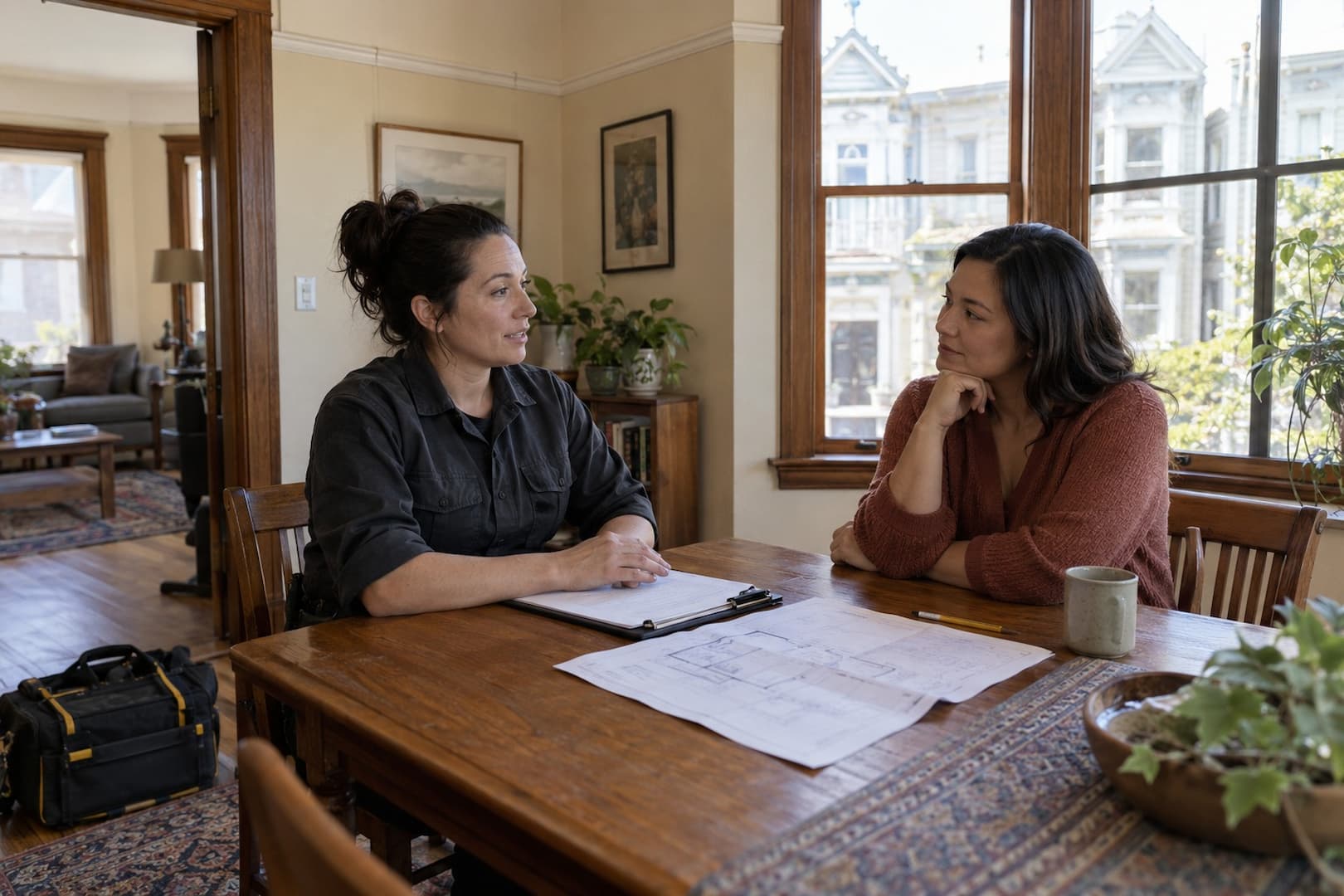
Ask for a description specific enough that a second electrician could understand the proposed work. “Replace cloth wiring” leaves room for disagreement over what the price includes. These questions help turn that phrase into a usable plan:
- Which wiring methods did you identify, and where? Ask the report to distinguish knob-and-tube, cloth-sheathed cable, and armored cable.
- Which old circuits are confirmed active? Request the affected rooms or devices and any areas that could not be checked.
- What finding requires correction? The answer should identify the defect, project requirement, or documented coverage condition.
- Will the work replace entire circuits or selected portions? Clarify what old wiring will remain in service and what will be disconnected.
- Does the price include permits, required protection, access openings, patching, painting, and final documentation? Record exclusions before work starts.
The San Francisco rewiring cost guide explains how access, circuit count, and finish restoration affect estimates. A fabric jacket cannot reveal those costs. Reaching wiring above an unfinished basement and reaching it behind finished plaster involve different work even when the cable looks identical.
When an inspection or insurance report says “cloth wiring”
Request the exact location and, if available, the supporting photograph. Then ask whether the report identified a wiring method or merely described a covering. Keep the insurer’s own wording: a question about active knob-and-tube may call for different documentation from a request to address all ungrounded circuits.
For a purchase or renewal deadline, get the carrier’s requirements in writing before commissioning work. An insurance electrical report can document observable conditions and the scope of testing, but the carrier makes its own coverage decision. Send the inspector’s photograph and the carrier’s request when booking the visit.