
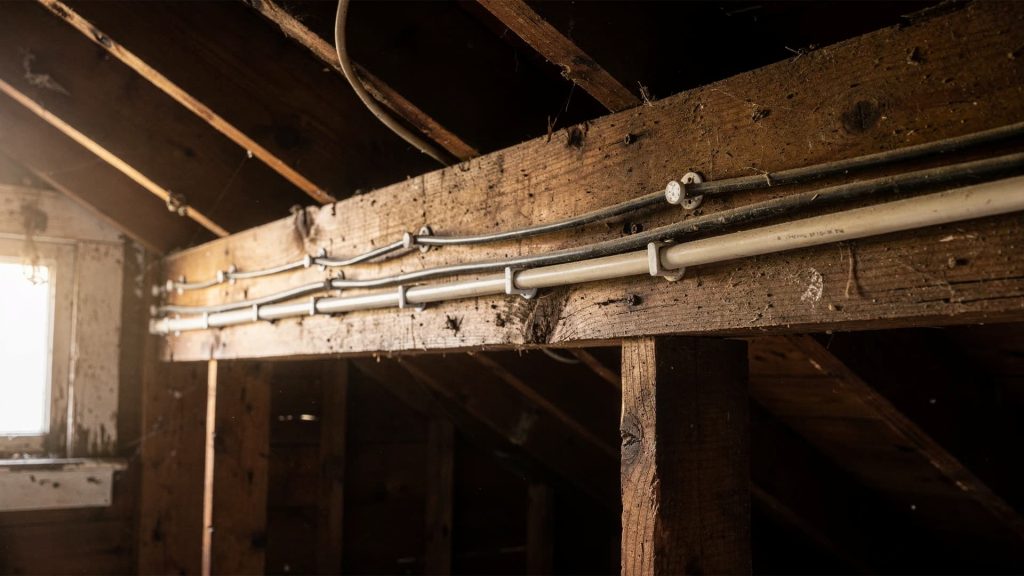
Short answer: what is knob and tube wiring?
Knob and tube wiring is an old style of electrical wiring that uses two separate insulated copper conductors, supported on ceramic “knobs” and protected by ceramic “tubes” where the wires pass through wood framing. It has no ground wire, relies on cloth or rubber insulation, and was commonly installed in homes built from the 1880s to the 1940s.
Many older San Francisco homes—especially pre-1940 buildings—still contain active knob and tube wiring in attics, basements, and wall cavities. Although this system worked well for early lighting circuits, it wasn’t designed for modern electrical loads, appliances, or today’s safety standards.
This guide will help you understand everything you need to know about knob and tube wiring:
- what it is
- how it works
- how to identify it
- safety concerns
- insurance implications
- whether you should replace it
- how electricians upgrade these systems today
- Short answer: what is knob and tube wiring?
- Why knob and tube wiring matters in San Francisco
- What exactly is knob and tube wiring?
- History: when knob and tube wiring was used
- How knob and tube wiring works
- What knob and tube wiring looks like
- Original advantages of knob and tube wiring
- Why knob and tube wiring is considered unsafe today
- Is knob and tube always dangerous?
- How to tell if your home has knob and tube wiring
- Code and insurance issues
- What replaced knob and tube wiring?
- Pros and cons of knob and tube wiring
- Frequently asked questions
- What electricians typically do when upgrading knob and tube
- When to call an electrician
- Final Thoughts
Why knob and tube wiring matters in San Francisco
San Francisco has one of the oldest housing stocks in the United States. A large percentage of homes were built before 1940, which means many properties originally had knob and tube wiring. In some cases, homeowners have partially upgraded circuits, but fragments of the original system often remain behind the walls.
Because San Francisco homes tend to have many remodels and additions over decades, it is extremely common to find:
- a mix of knob and tube, cloth-covered wiring, and modern Romex
- hidden splices in attics or crawlspaces
- knob and tube circuits still powering lights or outlets
- insulation added on top of wiring that was originally meant to stay exposed
Understanding this wiring method is essential for anyone who owns or plans to buy an older SF home.
What exactly is knob and tube wiring?
Short definition
Knob and tube wiring is an early standardized electrical system that uses two single conductors—one hot and one neutral—run separately through the house. Each wire is supported by porcelain knobs, and when passing through wood, it is protected by porcelain tubes. There is no grounding conductor, and all insulation is cloth or early rubber material.
Main components
Knob and tube installations include:
- Copper conductors (hot and neutral run separately)
- Porcelain knobs that hold wires away from wood
- Porcelain tubes that protect wires through holes in joists
- Cloth or rubber insulation around conductors
- Cloth “loom” sleeves used where wires enter metal boxes or fixtures
The wires are spaced apart and suspended in open air, which helped cooling when installed—but is now a limitation when insulation is added.
Where you’ll commonly see it
- Basement ceilings
- Attic floor joists
- Framing cavities of older walls
- Approaching old light fixtures
- Running along rafters or joists in clear view
When intact, it’s easy to spot because the white ceramic knobs and tubes stand out against wood framing.
History: when knob and tube wiring was used
Short answer
Knob and tube wiring was widely used across the United States from the late 19th century until the early 1940s. After World War II, it was phased out in favor of safer, easier-to-install armored cable and later non-metallic sheathed cable (Romex).
Timeline
- 1880s–1910s: Rapid adoption as electricity becomes standard in homes.
- 1910s–1930s: The dominant wiring method in residential construction.
- 1930s–1940s: Gradual transition to armored cable and modern electrical systems.
- Post-1940s: No longer installed in new homes; considered obsolete.
Because so many San Francisco homes were already built before 1940, knob and tube remains surprisingly widespread today.
How knob and tube wiring works
Short answer
Knob and tube wiring works by running a hot and a neutral conductor separately through the home. Electricity flows from the electrical panel to fixtures on the hot wire, and returns via the neutral wire. The system has no ground, uses open-air cooling, and relies on porcelain insulators to keep wires away from wood.
How the system is structured
A typical K&T circuit includes:
- Two separate conductors
- Hot and neutral wires run several inches apart.
- Support on knobs
- The wire is wrapped around or laid into a groove on the porcelain knob.
- Tubes for protection
- When a conductor passes through a drilled hole in wood, it runs through a porcelain tube.
- Soldered splices
- Early electricians often made soldered joints wrapped in friction tape and left them inside walls—not in junction boxes.
- Connections to fixtures
- Wires run into old metal boxes or directly to fixtures using cloth loom sleeves.
How it differs from modern wiring
- No ground wire
- Conductors are separate instead of bundled
- Many splices are hidden and inaccessible
- Insulation breaks down over time
- Not compatible with insulation installed in contact with wires
Although knob and tube circuits can still function, they don’t meet the expectations of modern electrical loads or safety standards.
What knob and tube wiring looks like
Short answer
Knob and tube wiring appears as single cloth-covered wires stretched along wood framing, supported on white ceramic knobs, and passing through white ceramic tubes in joists or studs.
Visual clues
In an attic or basement, K&T looks like:
- Long straight wires
- White ceramic knobs nailed to joists
- Wires disappearing into white tubes through wood
- Cloth insulation that may be discolored, cracked, or brittle
- Old-style two-prong ungrounded outlets in the living space
You may also find transitions where K&T meets modern cable—these splices are often not up to today’s electrical code.
Original advantages of knob and tube wiring
Short answer
When originally installed, knob and tube wiring was considered a high-quality and durable system. It offered air cooling, used good copper conductors, and was an inexpensive alternative to conduit.
Why it worked well 100 years ago
- Open-air cooling kept conductors from heating.
- High-quality materials (porcelain and copper) held up well for decades.
- Flexible routing allowed electricians to move wires easily through framing.
- Low household loads at the time (mostly lighting) were well within system limits.
But household electricity use has changed dramatically since then.
Why knob and tube wiring is considered unsafe today
Short answer
Knob and tube is unsafe today because it has no ground, its insulation deteriorates with age, it often contains hidden splices, and it cannot safely handle modern electrical loads or insulation contact.
Major risks of K&T in 2025
1. No grounding
- Modern electronics require grounding for surge protection and safety.
- Three-prong outlets cannot be properly grounded on original K&T circuits.
- Faults can energize metal appliances without tripping protection.
2. Insulation deterioration
Cloth and early rubber insulation breaks down over time. Common problems include:
- cracking
- fraying
- missing insulation
- rodent damage
Exposed conductors increase shock and fire risk.
3. Hidden splices in walls
Splices were often made without junction boxes and are now nearly impossible to inspect. Over decades, many homeowners or handymen added unsafe splices, twists, or wire-nut connections.
4. Incompatibility with insulation
Knob and tube wiring was designed to cool in open air. Covering it with blown-in insulation can trap heat, dry out insulation faster, and present a fire hazard.
5. Not designed for modern loads
Old circuits served minimal loads. Today’s homes demand far more power for:
- kitchens
- HVAC
- home offices
- large appliances
- entertainment systems
Old conductors are often overloaded when tied into modern breaker panels.
6. Insurance problems
Most insurance companies treat active K&T as a high-risk feature. Some:
- deny new policies
- require replacement
- require an electrician’s certification
- increase premiums
In San Francisco’s real estate market, this can impact resale value.
Is knob and tube always dangerous?
Short answer
Knob and tube wiring is not automatically a fire hazard if it is untouched and in perfect condition—but in real homes, it is rarely untouched or perfect after 80–120 years.
Practical reality
Even if some portions of K&T remain functional:
- The insulation is far older than intended.
- Many circuits have been extended, cut, modified, or spliced incorrectly.
- Home loads are significantly higher than what the wiring was built for.
Most electricians recommend at least planning a phased replacement even if everything appears to work.
How to tell if your home has knob and tube wiring
Short answer
Look in attics and basements for single cloth-covered wires on porcelain knobs or passing through porcelain tubes. But the safest approach is to have a licensed electrician inspect the home.
Homeowner checklist
1. Basement or crawlspace
Look at the underside of the floor:
- Wires supported on knobs?
- White tubes in joists?
- Cloth insulation?
2. Attic
- Single wires across joists
- Ceramic knobs visible
- Wires buried in insulation (a red flag)
3. Outlets and switches
- Many two-prong outlets
- Mixture of very old and newer switches
4. Electrical panel
- Old fuses
- Old labels
- Legacy circuits
A proper inspection includes testing circuits, assessing insulation condition, checking load levels, and identifying unsafe splices.
Code and insurance issues
Short answer
Knob and tube wiring isn’t automatically “illegal,” but new installations are not allowed, and existing K&T must be in safe condition. Many insurance companies strongly prefer replacement.
Code considerations
- New knob and tube wiring is not used in modern residential construction.
- Existing runs must be in good condition to remain.
- Insulation cannot be placed over knob and tube without evaluation.
- Splices must be in accessible junction boxes for any modifications.
Insurance considerations
Many insurers:
- refuse to insure homes with active K&T
- require replacement before binding a policy
- require certification from a licensed electrician
In San Francisco, this can slow or complicate real estate transactions.
What replaced knob and tube wiring?
Short answer
K&T was replaced by armored cable and later by modern non-metallic sheathed cable (Romex), which bundles hot, neutral, and ground together and requires all splices to be inside junction boxes.
Today’s wiring methods include:
- NM-B Romex
- MC metal-clad cable
- Conduit (EMT, flexible metal)
These systems provide grounding, safer installation practices, and compatibility with modern electrical codes and appliances.
Pros and cons of knob and tube wiring
Short answer
The pros only applied historically; the cons dominate today.
Pros
- Works if untouched and lightly loaded
- Porcelain insulators last indefinitely
- Air cooling helps with heat dissipation
Cons
- No ground
- Deteriorating insulation
- Numerous hidden splices
- Difficult to modify safely
- Incompatible with insulation
- Insurance issues
- Not suitable for modern home loads
For most homeowners, this results in a clear recommendation: plan an upgrade.
Frequently asked questions
What electricians typically do when upgrading knob and tube
Short answer
They add new grounded wiring, transfer circuits over, and safely disconnect the old K&T.
Steps involved
- Assessment & mapping
- Planning new grounded circuits
- Running new Romex or MC cable
- Moving fixtures and outlets onto new circuits
- Disconnecting old K&T at the panel
- Final inspection
The goal is to modernize the electrical system safely without unnecessary disruption.
When to call an electrician
You should have your home inspected by a licensed electrician if you notice:
- ceramic knobs or tubes
- cloth insulation
- mixed splices
- two-prong outlets
- wires buried in insulation
- flickering lights or breaker trips
Even if everything seems fine, a professional evaluation ensures your electrical system is safe and compliant.
Final Thoughts
Knob and tube wiring is part of the electrical history of San Francisco’s beautiful older homes. While it was a well-engineered system for its time, it isn’t aligned with modern electrical needs, safety expectations, or building practices.
If your home still contains knob and tube wiring:
- get it inspected
- understand where it runs
- evaluate its condition
- plan a phased upgrade
- protect your home, family, and investment