
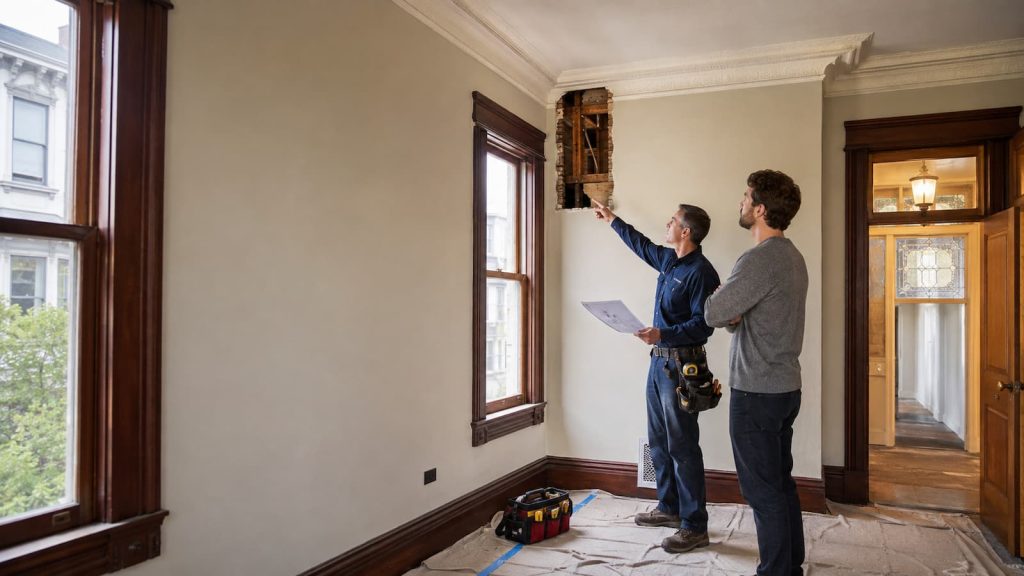
Updated September 2026. This guide explains how San Francisco rewire estimates are built, which costs are commonly separated, and what to verify before approving a proposal.
For early planning, $20,000–$50,000 is a reasonable conversation range for a typical multi-room knob-and-tube replacement in San Francisco. A small, accessible scope may fall below it. A large multi-story house with finished plaster, difficult routes, occupied-room phasing, panel or service work, and finish restoration can exceed $50,000. That range is a starting point—not a bid. The useful number comes after someone identifies which old circuits are still active and writes down what the price includes.
The short answer
The cost is driven less by the age printed on the property record than by five practical facts: how much knob-and-tube remains energized, where new cable can travel, how many finished surfaces must be opened, whether the existing panel can support the final plan, and who is responsible for patching and painting. If an estimate does not define those items, its total is hard to compare with anything else.
What does knob-and-tube replacement cost in San Francisco?
There is no citywide flat rate. “Replace the knob-and-tube” may describe one accessible lighting branch, several rooms, a condo, or every active legacy circuit in a three-story house. Those are different jobs. Some proposals also bundle a panel upgrade and wall repair; others price only the electrical work.
| Planning scenario | Useful budget signal | What still needs to be defined |
|---|---|---|
| Inspection and circuit tracing | Priced separately by access and testing scope | Rooms, representative tests, panel review, attic/basement/crawlspace access, and report format |
| Targeted accessible replacement | Quote by identified circuit or room—not as a “whole-house” price | Where the new run ends, what remains active, device work, patching, permit path, and labeling |
| Typical multi-room or whole-home project | $20,000–$50,000 as an initial planning range | Exact active scope, route plan, occupied-work sequence, panel/service work, permits, and restoration |
| Large or access-heavy historic home | $50,000+ is possible | Multiple floors, original plaster or millwork, blocked routes, service coordination, temporary power, and finish matching |
| Panel or utility service upgrade | Separate line item unless the proposal says otherwise | Load calculation, equipment, service rating, utility involvement, and related repair |
| Plaster, drywall, texture, and paint | Separate trade or allowance on many projects | Protection, openings, patching standard, texture match, primer, paint, and final cleanup |
If you need a number for a purchase decision or renovation budget, start with a knob-and-tube inspection and circuit trace. A few visible porcelain knobs do not establish how much old wiring is active. A newer panel does not prove the branch circuits were replaced, either.
Why price per square foot often misleads
Square footage is easy to ask for, so it appears in many online calculators. It is a weak substitute for a circuit map. Two 1,800-square-foot homes can have radically different labor requirements: one may have open basement joists and a usable attic; the other may have three finished levels, plaster ceilings, built-ins, fire blocking, and no continuous route.
A square-foot number can help decide whether a project is likely to be four figures or several tens of thousands. It cannot tell you how many access openings are needed, whether the kitchen already has modern circuits, or whether the service equipment belongs in the same scope. Treat it as a rough screening tool. Do not use it to compare bids unless the underlying assumptions match.
The seven cost drivers that matter most
1. What is still active
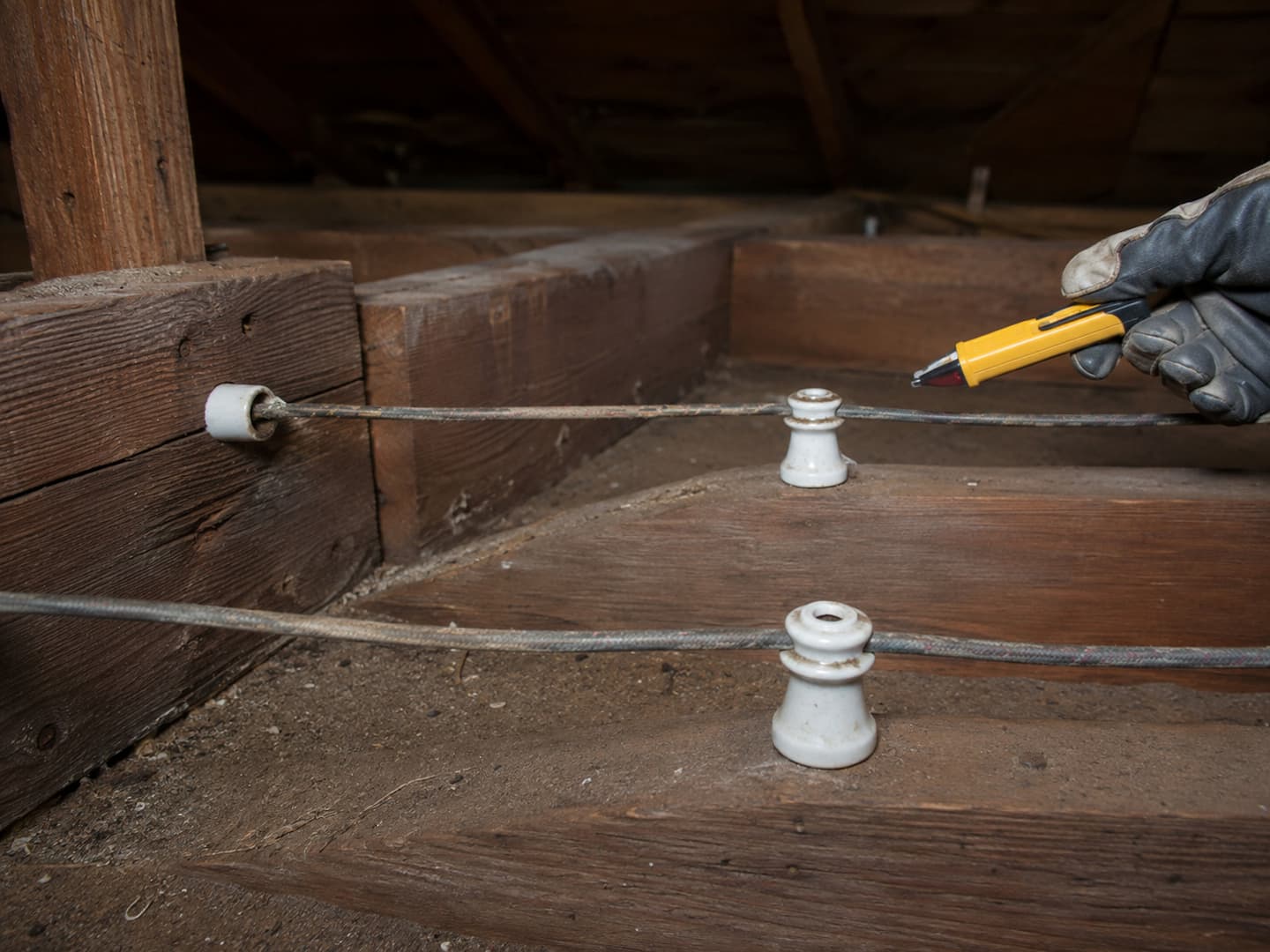
Old wiring may remain in an attic long after the rooms below were rewired. The reverse also happens: a remodeled kitchen can look modern while an older lighting branch remains energized elsewhere. Tracing separates visible history from active scope. It also prevents a proposal from quietly assuming that every old-looking conductor must be replaced—or that none of it matters.
2. Routes through the building
Attics, unfinished basements, crawlspaces, closets, stacked chases, and existing device openings can reduce invasive work. Finished ceilings, blocked joist bays, pocket doors, tile, built-ins, and additions can remove those options. In older San Francisco homes, routing is often the budget.
3. Plaster, woodwork, tile, and finish responsibility
“Minimal holes” is not a finish specification. Ask who protects floors and furniture, makes the openings, patches them, matches the texture, primes, and paints. An electrical contractor may coordinate some or all of that work, or the owner may hire a separate finish contractor. Both approaches can work. The problem is leaving the boundary unstated.
4. Occupancy and phasing
An empty home gives the crew more room to protect surfaces, open several work areas, and restore circuits in a practical sequence. In an occupied property, the job may need daily cleanup, temporary power decisions, shorter outages, and room-by-room access. That extra coordination is real work. It can be worth it, but it should not be invisible in the estimate.
5. Panel condition and service capacity
Replacing branch circuits does not automatically require a new 200-amp service. Nor does a newer panel solve old branch wiring by itself. The contractor should inspect the equipment, account for planned loads, and explain whether the project needs panel work, a service change, or neither. If capacity work is proposed, compare it as a distinct part of the electrical panel upgrade plan.
6. Devices, protection, and current project requirements
A rewire may involve more than cable. Boxes, receptacles, switches, fixtures, grounding and bonding, smoke/CO alarms, and AFCI or GFCI protection may be part of the permitted scope. Which items apply depends on the work and the existing building. A serious estimate names them rather than hiding them inside “bring to code.”
7. Unknown conditions and change-order rules
Closed walls contain surprises. Good proposals do not pretend otherwise. They identify the assumptions made during pricing and describe what happens if the crew finds blocked routes, damaged boxes, mixed wiring, undocumented splices, or another condition that changes the plan. That is much more useful than a low number followed by vague exclusions.
What should be included in a knob-and-tube replacement estimate?
Before comparing totals, compare the scope sheets. A complete proposal does not need to be long, but it should answer the questions below in plain language.
- Rooms and circuits: Which lighting, receptacle, appliance, or other branches are included?
- Existing wiring: What will be disconnected, what accessible material will be removed, and what may remain abandoned in closed cavities?
- New work: What cable or raceway, boxes, devices, breakers, grounding, and labeling are included?
- Access: Who makes openings, and what routes or concealed-condition assumptions support the price?
- Finish repair: Does the price include patching, texture, primer, paint, or none of those items?
- Panel and service: Are they included, optional, or specifically excluded?
- Permits and inspections: Who applies, which fees are included, and what counts as final completion?
- Schedule and outages: Is the home occupied, how will rooms be sequenced, and when will power be unavailable?
- Closeout: Will the owner receive updated panel identification, test results, photos, invoices, and permit status?
San Francisco permit fees: what the City actually publishes
Permit fees are not the same thing as the cost of the electrical work. San Francisco DBI’s electrical fee schedule, effective for permits issued on or after September 1, 2025, prices residential general-wiring permits by device count and inspection allowance. The published categories are shown below.
| Residential general-wiring category | Published DBI fee |
|---|---|
| Up to 10 outlets and/or devices; 1 inspection | $273 |
| 11–20 outlets and/or devices; up to 2 inspections | $426 |
| Up to 40 outlets and/or devices, including up to a 200-amp service upgrade; up to 3 inspections | $534 |
| More than 40 outlets and/or devices; up to 4 inspections | $734 |
| Residential building from 5,000 to 10,000 square feet; up to 5 inspections | $1,066 |
The $534 category does not mean a 200-amp service upgrade costs $534. It is the City’s listed permit and inspection fee category for qualifying work. Equipment, labor, utility requirements, plan review, extra inspections, and related building repairs are separate. The contractor should itemize the work on DBI’s electrical permit application worksheet, and the permit applicant needs the permit information when scheduling the electrical inspection.
Full replacement, targeted work, or a phased rewire?
A targeted project can make sense when the active legacy wiring is genuinely limited and the endpoint is clear. A phased rewire can make sense when occupancy, renovation timing, or budget makes a single mobilization impractical. Neither option should be described as a full replacement if active knob-and-tube remains.
Targeted scope
Best when testing identifies a bounded circuit or room and the new work can terminate safely. The closeout should say what remains outside the scope.
Phased replacement
Useful when work must follow a remodel or occupied-room sequence. Each phase needs a safe boundary, updated labeling, testing, and a record of what is still active.
Full active-circuit replacement
Appropriate when old wiring is widespread or the owner needs one coordinated plan. The phrase should still be tied to verified active circuits and stated inspection limits.
Phasing is not automatically cheaper. It may repeat setup, protection, access, patching, permitting, and testing. Ask for both the immediate phase price and the likely total path before deciding.
How long does replacement take?
A limited, accessible circuit and a whole occupied house should not share a timeline table. The schedule depends on circuit count, route discovery, access openings, inspection timing, finish repair, panel or service work, and whether rooms can be worked on at the same time.
Ask the contractor for milestones instead of a single optimistic finish date: assessment, written scope, permit issuance, site preparation, rough or progress inspection if required, circuit transfer, testing, finish restoration, final inspection, and owner handoff. Also ask which dates depend on DBI, PG&E, or another trade. That distinction matters when the property is vacant for only a short window.
Insurance and real-estate decisions
Insurance companies do not all ask the same question. One may want confirmation that no active knob-and-tube remains; another may request photos, an electrician’s report, a permit record, or a completed invoice. The carrier decides what it will accept. An electrician can document observable conditions and completed work but cannot guarantee underwriting or a premium reduction.
Get the request in writing before authorizing work. For a purchase or sale, use the buyer and seller electrical review to connect the finding, deadline, proposed correction, and completion record. If the request comes directly from a carrier, the insurance electrical report page explains the documentation limits.
Ways to control cost without weakening the scope
- Coordinate with planned renovation. Rewiring before cabinets, insulation, or finish painting may avoid reopening completed work.
- Clear safe access. Accessible panel space, attic hatches, basements, crawlspaces, closets, and device locations reduce time spent moving belongings. Do not remove covers or touch exposed wiring yourself.
- Resolve finish responsibility early. A separate plaster contractor is not necessarily more or less expensive; it simply needs to be in the budget and schedule.
- Compare alternates on the same base scope. Put optional panel work, added receptacles, surge protection, or smart-home preparation on separate lines.
- Keep records together. Inspection notes, photos, permits, invoices, panel identification, and test results can prevent later confusion about what was actually replaced.
How to choose an electrician for the estimate
Ask who will trace the circuits, how the crew plans routes in finished rooms, what happens when the first route is blocked, and how the old wiring will be documented at closeout. Check the contractor’s current license status rather than relying on a logo or a statement in an ad. The California Contractors State License Board defines the C-10 Electrical Contractor classification and provides an online license check.
Experience with older San Francisco buildings matters most when it changes the plan: fewer exploratory openings, clearer finish coordination, realistic outage sequencing, and better records. The value is not the phrase “historic-home specialist.” It is a proposal that shows how the house will actually be approached. You can also review the existing Pacific Heights project page as a project example rather than treating it as a generic service page.
Frequently asked questions
What is the average cost to replace knob-and-tube wiring in San Francisco?
For early planning, use roughly $20,000–$50,000 for a typical multi-room or whole-home conversation. Smaller accessible scopes may be less; large, multi-story, finish-sensitive, or service-heavy projects can exceed $50,000. An average is not a substitute for tracing active circuits and defining access, permit, panel, and repair responsibilities.
Can I estimate the project by square foot?
Only for a rough first screen. Square footage misses active circuit count, vertical routes, blocked framing, finished surfaces, occupancy, panel work, and device changes. Those variables usually explain why similarly sized homes receive different estimates.
Does the price include a new electrical panel?
Not unless the proposal says so. Branch-circuit replacement, panel replacement, and a utility-involved service upgrade should be separate scope items. The existing equipment and planned loads determine what is needed.
Is plaster repair included?
It varies. The quote should identify who makes and patches openings, matches texture, primes, paints, and handles protection and cleanup. If the electrician excludes finish work, obtain the companion repair budget before comparing totals.
Is it cheaper to rewire before moving in?
Often it is easier to schedule and sequence, and several rooms may be available at once. The savings depend on access and scope, so ask the contractor to price the vacant and occupied approaches if timing is flexible.
Can knob-and-tube replacement be phased?
Sometimes. Each phase needs a safe circuit boundary, testing, updated labeling, and a clear record of the wiring that remains active. Repeated access and mobilization may make the total phased cost higher.
Does all of the old wire have to be removed?
The proposal should distinguish de-energizing from physical removal. Accessible old material may be removed, while abandoned conductors may remain in closed cavities when appropriate. What matters is that the active system, disconnection method, and inspection limits are documented.
How do I get a reliable estimate?
Send any home-inspection or insurance request, then arrange safe access to the panel and available attic, basement, crawlspace, and device locations. Ask for a written scope with inclusions, exclusions, options, concealed-condition assumptions, permit responsibility, and finish boundaries.
Get a property-specific replacement estimate
Tell us what prompted the estimate—an inspection, an insurance request, a planned renovation, or signs of active old wiring. We will start with the evidence available and define the next useful step. Call (415) 371-8890 or use the form below.